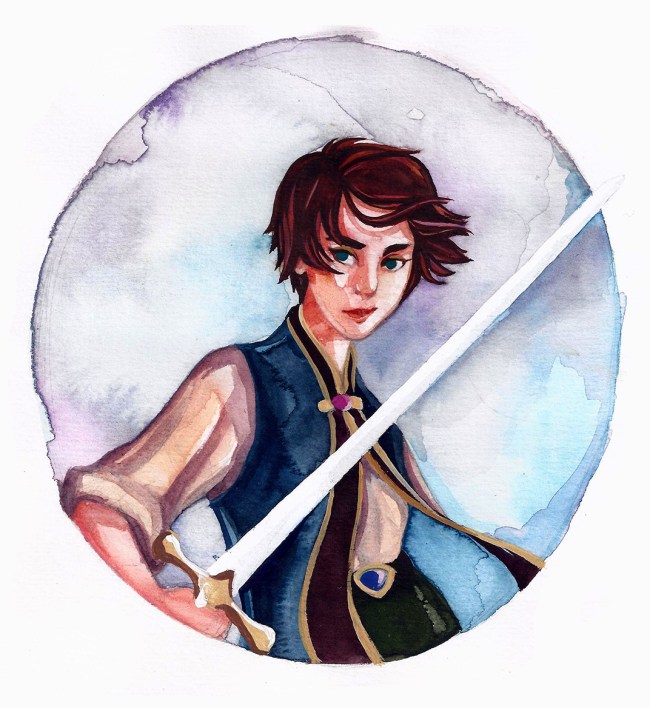
Arya and Needle in The Winds of Winter

arya_stark_by_threkka-d5qo6bj

When Arya stabs Raff the Sweetling in TWoW sample chapter “Mercy” she uses a “long thin blade” that was evidently hiding up her sleeve:

Raff the Sweetling looked up sharply as the long thin blade came sliding from her sleeve. She slipped it through his throat beneath the chin, twisted, and ripped it back out sideways with a single smooth slash. A fine red rain followed, and in his eyes the light went out.

This is not the first long, thin blade we’ve seen Arya with. Both text and symbolism strongly hint that the blade that does Raff in is none other than Needle, last seen being hidden under a loose stone on the steps leading to the House of Black and White.

Just before this she has apparently sliced his femoral artery with a different knife, most likely a small, sharp one that could be easily palmed:

Instead she slid her finger down along the inside of his thigh. He gave a grunt. “Damn, be careful there, you — “

Mercy gave a gasp and stepped away, her face confused and frightened. “You’re bleeding.”

We know from ADwD that she is adept at palming small knives:

It took her three more days of watching before she found the way, and another day of practicing with her finger knife. Red Roggo had taught her how to use it, but she had not slit a purse since back before they took away her eyes.

[…]

she sharpened the steel on a whetstone until its edge glimmered silver-blue in the candlelight.

[…]

Last of all she palmed her finger knife.

[…]

Her blade flashed out, smooth and quick, one deep slash through the velvet and he never felt a thing.

At the outset of “Mercy” we witness her preparing to go to the theater:

Her boots were lumps of old brown leather mottled with salt stains and cracked from long wear, her belt a length of hempen rope dyed blue. She knotted it about her waist, and hung a knife on her right hip and a coin pouch on her left. Last of all she threw her cloak across her shoulders. It was a real mummer’s cloak, purple wool lined in red silk, with a hood to keep the rain off, and three secret pockets too. She’d hid some coins in one of those, an iron key in another, a blade in the last. A real blade, not a fruit knife like the one on her hip, but it did not belong to Mercy, no more than her other treasures did. The fruit knife belonged to Mercy. She was made for eating fruit, for smiling and joking, for working hard and doing as she was told.

Of note, she has a small, sharp knife on her hip (the fruit knife) and another “real blade” secreted in her cloak. This blade does not belong to Mercy, though the fruit knife does, distinctions of ownership we think are significant.

Arya has not been called Arya Stark in her own PoV since the Cat of the Canals chapter in AFfC. When she wakes up as the Blind Girl in ADwD, she is no longer called Arya by the Kindly Man, though she does occasionally recall that she was once called Arya Stark. Since becoming the Blind Girl, Arya has been a creature of the Faceless Men, playing their roles, learning their ways and obeying their rules. In fact, she initiates her exquisite slaying of Raff as Mercy, using Mercy’s fruit knife to make the first cut.

During the murder, Mercy guides Raff into asking her to carry him, just as Lommy did way back in ACoK (For the record, the Lommy & Raff killings have numerous other clear parallels beyond the scope of this essay)

“Walk?” His fingers were slick with blood. “Are you blind, girl? I’m bleeding like a stuck pig. I can’t walk on this.”

“Well,” she said, “I don’t know how you’ll get there, then.”

You’ll need to carry me.”

See? thought Mercy. You know your line, and so do I.

“Think so?” asked Arya, sweetly.

Note the question “Are you blind, girl?” to which the answer is a clear “No.” This just might signify that Mercy is no longer a creature of the FM as of that moment, especially since when Raff says his “line” a moment later Mercy becomes Arya for the first time since Arya became the Blind Girl, and evidently uses the blade that “did not belong to Mercy” to complete the killing.

Back in AGoT Arya received a special gift from her brother Jon:

She giggled at him. “It’s so skinny.”

“So are you,” Jon told her. “I had Mikken make this special. The bravos use swords like this in Pentos and Myr and the other Free Cities. It won’t hack a man’s head off, but it can poke him full of holes if you’re fast enough.

[…]

“Needle!”

We see evidence of Needle being a relatively small blade when, after Arya recovers Needle at the Inn after the Hound kills Polliver, we get this description:

Hanging beside his dagger was a slimmer blade, too long to be a dirk, too short to be a man’s sword… but it felt just right in her hand.

And later on in AFfC:

Needle was too small to be a proper sword, it was hardly more than a toy.

So Needle could probably best be described as a “long, thin blade.” Fitting Needle into her mummers cloak wouldn’t be difficult given GRRM regularly does impossible things with swords (like people drawing greatswords over their shoulder) – and after all he’s already told us the blade was long.

Recall that after Arya trains with the Braavosi water dancer, Syrio Forel, Needle became an iconic part of her Stark identity.

Needle was Robb and Bran and Rickon, her mother and her father, even Sansa. Needle was Winterfell’s grey walls, and the laughter of its people. Needle was the summer snows, Old Nan’s stories, the heart tree with its red leaves and scary face, the warm earthy smell of the glass gardens, the sound of the north wind rattling the shutters of her room. Needle was Jon Snow’s smile.

In her thoughts, Needle stands for her family, replacing her need for friends (“I don’t need any friends, so long as I have Needle”) and is her constant protection:

“She slid Needle out from under her cloak. The slender blade seemed very small and the dragons very big, yet somehow Arya felt better with steel in her hand.”

[…]

“She went back to sleep clutching Needle.”

[…]

“Needle was in her hand, though she did not remember drawing it”

What better blade to use when taking vengeance for her losses? Back in AFfC she hid it on the steps of the HoBaW:

She padded up the steps as naked as her name day, clutching Needle. Halfway up, one of the stones rocked beneath her feet. Arya knelt and dug around its edges with her fingers. It would not move at first, but she persisted, picking at the crumbling mortar with her nails. Finally, the stone shifted. She grunted and got both hands in and pulled. A crack opened before her.

“You’ll be safe here,” she told Needle. “No one will know where you are but me.” She pushed the sword and sheath behind the step, then shoved the stone back into place, so it looked like all the other stones. As she climbed back to the temple, she counted steps, so she would know where to find the sword again. One day she might have need of it. “One day,” she whispered to herself.

Between the similarities of description in the text, and the symbolism of Mercy becoming Arya Stark just before the blade appears, we think that the most likely conclusion is that the blade that kills Raff is none other than Needle. The blade sliding out of her sleeve could be the symbolic realization of Syrio Forel’s very first advice to her:

“The steel must be part of your arm,” the bald man told her.


Co-written with yolkboy

As discussed in Radio Westeros Episode 1 — A Gift of Mercy

Subscribe Here

Art by Threkka

Arya’s New Face: Jeyne Poole?

It’s difficult to predict what the future holds for Arya, even after reading the Mercy chapter from The Winds of Winter. With so few clues to go on, it’s worth considering storytelling logic to gather ideas and then see if the text supports them.

Identity is a huge theme in these books for many characters, but especially for Arya who has had eighteen different names and personas at this stage. GRRM likes to attack the issue of identity from all angles, and each book reveals a new layer to the theme–from multiple characters being reborn with altered selves to Bran inhabiting Hodor. Identity is so closely tied to Arya’s arc it might be a good idea to consider how GRRM might chose to advance her story by furthering this theme–taking Arya and identity to the next level.

With Arya now wearing faces of the dead with the Faceless Men, it seems likely that her association with new identities would develop through this channel. It’s interesting to consider whose face Arya could end up wearing, especially when she returns to Westeros, which would not only further the identity theme, but also provide the most intriguing opportunities from a storytelling perspective. The identity that Arya could adopt which be the most poetic and lend itself to the most fascinating story dynamics would unquestionably be that of  ‘fake Arya’–Jeyne Poole. After examining ADwD and the TWoW sample chapters, the opportunity for Arya to wear Jeyne’s face seems quite plausible.

First of all, the Faceless Men of Braavos would need to obtain Jeyne’s face, which would require her to go to Braavos in the near future. In ADwD, Jon believes Arya has arrived at the Wall. It turns out to be Alys Karstark, but before realising this, Jon thinks his ‘sister’ “won’t be safe” and that “The Wall was no place for a woman, much less a girl of noble birth.”.

His first idea to keep the girl safe is to send her to Braavos with the Iron Bank representative:

“She could return to Braavos with Tycho Nestoris”

Tycho is heading back to Braavos, and there’s logic in sending ‘Arya’ away from Westeros and the Wall to the nearest Free City, a relatively safe, civilised place as yet untouched by war. Alys approaching the Wall on a dying horse is a clear parallel with Jeyne Poole who, based on the Theon sample, is going to be doing exactly the same thing in TWoW. Even more intriguing is that Jeyne is currently in the company of Tycho Nestoris, who plans to go to Braavos with Justin Massey once he reaches the Wall. Here are some passages from the Theon chapter:

Stannis nodded. “You will escort the Braavosi banker back to the Wall. Choose six good men and take twelve horses.”

“To ride or eat?” (parallel with Alys on her dying horse)

“The king was not amused. “I want you gone before midday, ser. Lord Bolton could be on us any moment, and it is imperative that the banker return to Braavos. You shall accompany him across the narrow sea.”

“Oh, and take the Stark girl with you. Deliver her to Lord Commander Snow on your way to Eastwatch.”

In the aftermath of Jon’s stabbing, it’s highly likely the Wall will be a more dangerous place than ever. Alysane Mormont is accompanying Jeyne, and it seems very unlikely she will abandon the young girl (whom she thinks is Arya Stark), in a dangerous situation. The most logical choice to make, which might have already been foreshadowed by Jon’s thoughts on what to do with the girl he thought was Arya–-is to send her to Braavos.

If Jeyne is to go to Braavos, she would need to ask for ‘the gift’ at the House of Black and White for the Faceless Men to obtain her face. From what we know of Jeyne, this is something that seems plausible. Jeyne seemed like a happy girl early on in the books, but was forced into prostitution after her father was executed and then suffered untold and horrific abuse at the hands of Ramsay Bolton in the guise of Arya Stark. Although she has escaped, her inner torment isn’t even close to being resolved. In the Theon sample, we realise that  Jeyne must continue to pose as Arya–-she is caught in the worst identity crisis imaginable. Jeyne can’t shed her past; she’s forced to continue posing as someone she is not, someone who has truly suffered. We see how this effects her:

“Jeyne Poole had wept all the way from Winterfell to here, wept until her face was purple as a beetroot and the tears had frozen on her cheeks, and all because he told her that she must be Arya

Imagine thinking you are saved, only to be told you must continue to be this character whose life has been misery and pain. This psychological torment is not Jeyne’s only source of pain though. In the sample chapter, her nose is frostbitten:

“When the tip of her nose turned black from frostbite, and the one of the riders from the Night’s Watch told her she might lose a piece of it, Jeyne had wept over that as well.”

This is a girl who had probably always imagined herself growing up to be an attractive young lady. She says she had always been pretty in ADwD. But Jeyne is continually weeping now, and with good reason: her family and friends are dead, her mind in ruin, her body abused, and her face about to become disfigured.

So Jeyne Poole has reason to feel hopeless and perhaps want to visit the house of Black and White and ask for ‘the gift’, if she found herself in Braavos. This would provide the Faceless Men with a very valuable face, and GRRM with abundant storytelling opportunities regarding Arya.

Theon assures Jeyne that ‘no one’ will care what “Arya” looks like. We saw in the Mercy chapter with Raff’s line “are you blind girl?” that GRRM likes to make plays on Arya’s names, and this would be another such play using ‘no one’:

No one will care what Arya looks like, so long as she is heir to Winterfell,” he assured her.

The storytelling potential, if Arya were to wear Jeyne’s face and return to Westeros, is truly fascinating. The possibilities this situation would lead to are many, and foremost among them would be Arya bringing about Ramsay’s death by feeding his dogs basilisk’s blood.

But Arya appearing as Jeyne and then meeting Sansa would probably be the ultimate in terms of dynamics; and GRRM’s theme of identity would have advanced to yet another level. Jaqen H’ghar posing as Pate showed us that taking a face is a full body glamour rather than just the face, and with Arya’s experience we learned the wearer learns something of the face’s original owner. Such knowledge could lead the real Arya directly to Ramsay, and with the evidence from the text, and the storytelling opportunities outlined here, we see no reason why Arya Stark couldn’t one day become (f)Arya Stark.

Co-written with yolkboy

As discussed in Radio Westeros Episode 01: Arya- A Gift of Mercy

Subscribe

Mercy as Shae in The Bloody Hand

bloody hand

In GRRM’s latest TWoW spoiler chapter “Mercy”, Arya is continuing her apprenticeship with the Faceless Men by learning the mummer’s art with Izembaro and the company of The Gate. The play currently in production is “The Bloody Hand” by Phario Forel and as the chapter unfolds we learn it is to be performed in honor of an envoy from the Seven Kingdoms. Mercy is playing the role of a girl who is raped and murdered by the dwarf, a not-so-subtle caricature of Tyrion Lannister, whom we believe to be inspired by the whore Shae.

Our first hint that the characters in the play correspond to people in Westeros comes when we learn “The Bloody Hand offered two kings, the fat one and the boy. Izembaro would play the fat one. It was not a large part, but he had a fine speech as he lay dying, and a splendid fight with a demonic boar before that.” No doubt as the author intended, we immediately think of King Robert. The Queen, played by Lady Stork, wears a cloth of gold gown and imbibes in a glass of wine before each performance. Undoubtedly this is Cersei. The boar itself and the Stranger, the personification of Death in the Westerosi religion, are each given distinct parts. But it is the character played by the dwarf Bobono, referred to as “the Imp” by Mercy, who appears to be not only the central character but also the most significant correlate to Westerosi current events. The dwarf’s entrance is followed by these words:

“The seven-faced god has cheated me… My noble sire he made of purest gold, and gold he made my siblings, boy and girl. But I am formed of darker stuff, of bones and blood and clay…”

If a dwarf in the midst of a story about Robert Baratheon and a boar wasn’t clue enough, this seems like proof positive that Bobono’s character is Tyrion Lannister. Shortly after we get Mercy’s line “I’ll come back after the Imp’s done raping me.”

The meaning of Mercy’s “tonight I’ll be raped and murdered” is becoming clear. It’s perhaps understandable that many at first believe this young girl to be Sansa. Besides Sansa’s well known connection with Tyrion Lannister, her familiarity as a character and the delicious notion of Arya performing as her own sister, we have the fact that Mercy’s character is described as an innocent young maiden (“Please, m’lord, I am still a maiden”) But given the very first information we have about the character is “…tonight I’ll be raped and murdered” it seems clear that we should look elsewhere to identify Mercy’s character, as Sansa was neither raped nor murdered.

By examining the events that led to this play appearing at this time in Braavos we can gain a great deal of insight on the identity of this young maiden. The death of Robert Baratheon is clearly referenced, but we find several subtle references to events following the death of the boy king in Westeros, notably the trial of Tyrion Lannister and his subsequent murder of his father and Shae.

During Tyrion’s trial, we get this testimony from Shae:

“…He used me every way there was, and… he used to make me tell him how big he was. My giant, I had to call him, my giant of Lannister.” […] The sudden gale of mirth made the rafters ring and shook the Iron Throne. “It’s true,” Shae protested. “My giant of Lannister.” The laughter swelled twice as loud.

It’s easy to believe this detail becoming a part of the chain of chinese whispers that led to “The Bloody Hand” being written in Braavos when we return to this detail from the play:

Bobono’s cock was indeed flopping out. It was made to flop out, for the rape. What a hideous thing, Mercy thought as she knelt before the dwarf to fix him. The cock was a foot long and as thick as her arm, big enough to be seen from the highest balcony.

And further testimony from Shae:

I wasn’t only Lady Sansa’s maid. I was his whore, all the time he was here in King’s Landing. On the morning of the wedding, he dragged me down where they keep the dragon skulls and fucked me there with the monsters all around. And when I cried, he said I ought to be more grateful […] “I never meant to be a whore, m’lords. I was to be married. A squire, he was, and a good brave boy, gentle born. But the Imp saw me at the Green Fork and put the boy I meant to marry in the front rank of the van, and after he was killed he sent his wildlings to bring me to his tent. Shagga, the big one, and Timett with the burned eye. He said if I didn’t pleasure him, he’d give me to them, so I did. Then he brought me to the city, so I’d be close when he wanted me. He made me do such shameful things…

Not only do we find the language here that echoes Mercy’s line “Please, m’lord, I am still a maiden” and a clear insinuation that Tyrion raped Shae on more than one occasion, but we also see Shae protesting her former innocence (maidenhood) while reminding the court that she was Lady Sansa’s maid.

One more line of dialogue from the play that seems to clearly place its origins at the trial is:

“As I cannot be the hero, let me be the monster, and lesson them in fear in place of love”

Compare with Tyrion’s outburst at his trial:

“You make me sorry that I am not the monster you would have me be, yet there it is.”

While Tyrion is referred to (even by himself) as a monster repeatedly, this is the most public such reference and it comes at the event where we find the origins of the main action of the play, the rape and murder of the maiden played by Mercy in the second act.

As for the rape and murder themselves, we must take a look at the events surrounding the discovery of Shae’s body in Lord Tywin’s bed. First in a clever nod from the author to the chinese whispers that lead to a story like this getting around, we have

The hall was full of fools speaking in whispers […] Guards and servants alike shrank back before her, mouths flapping.

Then Cersei’s discovery of the body:

She strode to the bed, flung aside the heap of bloody coverlets, and there she was, naked, cold, and pink… save for her face, which had turned as black as Joff’s had at his wedding feast. A chain of linked golden hands was half-buried in the flesh of her throat, twisted so tight that it had broken the skin.

Probably not a leap to imagine that those golden hands embedded in the broken skin are bit bloody (thus the bloody coverlets.) Not to mention that Tyrion, the former Hand of the King, has the figurative blood of both Shae and his father on his hands. Nor can it be a leap to imagine that her naked state might lead some witnesses to assume she had been raped, especially since she had insinuated at the trial that Tyrion had done exactly that on more than one occasion.

Cersei commands the Kettleblacks to remove the girl and adds-  “No one is ever to know that she was here.” However, we know that the Kettleblacks work for Littlefinger and we have no reason to trust in the discretion of the other guards and servants who had already borne witness to the corpse.

So here we are with a young woman closely associated with Tyrion Lannister, who has protested her own innocence in a public forum,  whose naked and strangled body is discovered moments after Tyrion is known to have murdered his own father. Shae ticks all of the boxes of Mercy’s character in a way Sansa does not. For this reason we conclude that Mercy’s maiden is indeed Shae.

As discussed in Radio Westeros Episode 01: Arya — A Gift of Mercy

Subscribe

co-written with yolkboy

Copyright Radio Westeros 2014


Radio Westeros is Here!

Launching a new podcast is a lot like starting a small business. Content production is a breeze compared to recording, editing, licensing, designing and setting up websites and the like. But… after weeks of navigating the technological hinterland we are live! Here’s the description:

Radio Westeros Episode 01: Arya- A Gift of Mercy 

Arya Stark in George R.R.Martin’s A Song of Ice and Fire (ASoIaF): The Winds of Winter

Looking at Arya Stark in The Winds of Winter, yolkboy and Lady Gwyn analyse Arya in her new role with Izembaro. The recent gift chapter reveals themes of sexuality, identity and (as the chapter title indicates) mercy. Using specially arranged readings to present key sections, we discuss Arya’s identity, the role she plays in “The Bloody Hand” and why we think Needle makes an appearance late in the chapter. We also offer our unique speculation about Arya’s future and a new role her Faceless Men training could be preparing her for.

Subscribe through the Apple store, follow us on tumblr, twitter, or Facebook, visit our site or direct download here.

Episode 02 will follow in July, with more discussion, theorizing, music and a special guest. Don’t miss it!

RW sq

Radio Westeros Update

Progress Update 14 May 2014

We are hard at work producing Episode 01 of Radio Westeros. This is a very exciting project, although not without challenges. Our goals are to provide entertainment for fellow asoiaf fans while maintaining a fun and informative atmosphere and avoiding the bogeymen that seem to lurk in every corner. Oh, and we will have top notch sound quality!  And course it will be free for all.

Updates and links can be found on our tumblr and we are also on Facebook and Twitter @RadioWesteros

I don’t want to give away too much, but our inaugural episode will be a gift for our listeners, Arya style. Here’s another hint:

Image

The Sun and the Moon: The Sisterhood of Sansa and Arya Stark

arya_and_sansa_by_arashell-d4toyh1

art by Arashell

The following essay first appeared in a slightly different form on the Pawn to Player thread at westeros.org, as a part of their Female Influences project. Reprinted here with many thanks to PtP co-hosts Milady of York and brashcandy for involving me in this endeavor.

When thinking of Sansa and Arya Stark readers often tend to see them as opposites, from their first scene to their last. Though this opposition of characters is undeniable, it doesn’t mean that opposites have to be always in conflict. A complementary interpretation is possible, as the following incident illustrates:

In AGoT, chapter 65, Arya wonders why Sansa is on the steps of the Great Sept as their father is brought before the mob, and why she looks “so happy.” The reader knows that Sansa has used her courtesy and her pretty words, a lady’s armour and weapon, to buy her father’s life:

“As it please Your Grace, I ask mercy for my father, Lord Eddard Stark, who was Hand of the King.” She had practiced the words a hundred times. […] King Joffrey looked her up and down. “Your sweet words have moved me.” He said gallantly, nodding, as if to say all would be well. “I shall do as you ask … but first your father has to confess …”  ” AGoT, chapter 57

When it becomes clear that Joffrey is ordering Ned’s execution, Arya

 … threw herself into the crowd, drawing Needle […] Arya slashed at them with Needle […] She could still hear Sansa screaming.

At first glance these are two very different reactions to the same situation: Sansa— accommodating and sensitive, attempts to create a shield for her father, while Arya— belligerent and headstrong, would use her sword to defend him. On closer examination, the two girls doing exactly the same thing: using their individual talents in an effort to defend and save their father’s life. Their talents and actions in this situation are complementary, but their objective is the same.

Sisterhood refers to the relationship of two females who share a parent or parents. But a secondary definition of the word is “the solidarity of women based on shared conditions, experiences, or concerns.” While GRRM admittedly created Arya and Sansa as complementary characters, I propose that the shared bond of their sisterhood has embedded a blueprint in the arc of each girl, that their arcs and the roads each has to travel after their parting in King’s Landing move in tandem each to the other, along seemingly opposite paths, but progressing towards a common outcome: reunion with their family and the reformation of the pack. Ned’s words to Arya in AGoT reflect the values the girls were raised with, which will affect this outcome:

“Let me tell you something about wolves, child. When the snows fall and the white winds blow, the lone wolf dies, but the pack survives. Summer is the time for squabbles. In winter, we must protect one another, keep each other warm,  share our strengths. So if you must hate, Arya, hate those who would truly do us harm … Sansa is your sister. You may be as different as the sun and the moon, but the same blood flows through both your hearts. You need her, as she needs you …” AGoT,, chapter 22

From the beginning, we are alerted to the differences between the two girls:

“Sansa’s work is as pretty as she is,” Septa Mordane told their lady mother once. “She has such fine, delicate hands.” […] “Arya has the hands of a blacksmith.” AGoT, chapter 7

Sansa even points out the difference to Cersei, in a moment of self defence:

“I’m not like Arya,” Sansa blurted. “She has the traitor’s blood, not me. I’m good…” AGoT, chapter 51

Yet, are they really so different? Septa Mordane, she of the blacksmith hands analogy, has this sentiment for Sansa, who loved Lady as much as Arya loved Nymeria:

“You’re a good girl, Sansa, but I do vow that when it comes to that creature you’re as willful as your sister Arya.” AGoT, chapter 15

Even in their occasional indifference to each other, there are similarities:

“It was not until later that night, as she was drifting off to sleep, that Sansa realized she had forgotten to ask about her sister.” AGoT, chapter 51

Not to be outdone, Arya initially spares no thought for her sister once she escapes the horrors of King’s Landing:

“when at last she slept, she dreamed of home … She yearned to see her mother again, and Robb and Bran and Rickon . . . but it was  Jon Snow she thought of most.” ACoK, chapter 1

Shortly we see both girls having thoughts of their home and the “pack”, coupled with assertions of their defenses:

What was it that Septa Mordane used to tell her? A lady’s armour is her courtesy,  that was it. She donned her armour and said, “I’m sorry my lady mother took you captive, my lord.” […] Once she had loved Prince Joffrey with all her heart, and admired and  trusted his mother, the queen. They had repaid that love and trust with her father’s head. Sansa would never make that mistake again. ACoK, chapter 2

Sansa resolves to armour herself in courtesy, steeling her heart against the girlish love and admiration that once filled it. While for Arya we see a resolution to stand fast with sword in hand:

It made her sad to think of Sansa and her father. […] If she was a real water dancer, she would go out there with Needle and kill all of them, and never run from anyone ever again […] Arya wouldn’t let them die for her like Syrio. She wouldn’t! Shoving through the hedge with Needle in hand, she slid into a water dancer’s stance. ACoK, chapter 5

As Yoren leads her towards Harrenhal, Arya’s hope that she will find someone to rescue her sounds like an echo of her sister:

That was what knights did; they kept you safe, especially women. ACoK, chapter 14

We know Sansa has long believed in true knights, and while she still hopes, we begin to see the cracks in her conviction:

Knights are sworn to defend the weak, protect women and fight for the right, but none of them did a thing.  ACoK, chapter 32

“True knights protect the weak.” He snorted. “There are no true knights, no more than there are gods.” […] Wordless, she fled … there are gods, she told herself, and there are true knights too. All the stories can’t be lies. ACoK, chapter 52

Arya’s hope begins to fade as well after she is taken by The Mountain’s men:

By the time she marched, Arya knew she was no water dancer […]Syrio would never have sat silent in that storehouse, nor shuffled along meekly with the other captives. The direwolf was the sigil of the Starks, but Arya felt more a lamb, surrounded by a herd of other sheep. ACoK, chapter 26

In ACoK, chapter 18, Sansa receives a mysterious message saying “Come to the godswood if you want to go home.” Her thoughts at first are full of fear of betrayal, yet she resolves to go:

If it is some trap, better that I die than let them hurt me more.”

Over the course of several months, Sansa meets Ser Dontos in the godswood of the Red Keep, forging an alliance that she believes will take her home to Winterfell once and for all. During those months, we hear the following words in her internal monologue on more than one occasion echoing the resolve she felt on her visit, “I can be brave.” In fact, Sansa tells herself to “be brave” so many times in her final chapters in King’s Landing, it seems to have become her mantra.

By the time she flees King’s Landing in ASoS chapter 61, Sansa’s emotional shield is fully functional. Her internal monologue has grown increasingly rebellious, while the façade she presents to the world is all courtesy and pleasant words. As Tyrion tells her, “You hide behind courtesy as if it were a castle wall.” Yet as she flees, she feels her skin has turned “to porcelain, to ivory, to steel…”

Meanwhile at Harrenhal, Arya has been finding her courage and visiting the godswood as well. Arya uses her time in front of the heart tree to practice her needlework, recite her ever growing litany of judgement, and pray:

I was a sheep, and then I was a mouse, I couldn’t do anything but hide […] Jaqen made me brave again. He made me a ghost instead of a mouse. ACoK, chapter 26

Help me you old gods …Help me get those men out of the dungeon so we can kill Ser Amory, and bring me home to Winterfell. Make me a water dancer and a wolf and not afraid again, ever. ACoK, chapter 47

Arya finds her prayers answered in the form of Jaqen and weasel soup. Sansa’s prayers for delivery seem to be answered by Ser Dontos. But prayers, as we soon see, can be answered in unexpected ways. While Dontos ultimately spirits Sansa away, it is not yet to Winterfell; and while Jaqen does help Arya to free the northmen, which leads to the death of Amory Lorch, and is indeed the agency that allows Arya to rediscover her identity and conquer her fear, neither are Arya’s prayers for home answered. Both girls are set to move into a new phase of their journeys, but in paying homage to the gods of their father each has strengthened their gift– the shield has become steel, and the sword arm stiffened.

The next major settings in the arcs of the two girls are Braavos and the Vale. In the interim, between godswoods and the destinations, each forms a brief alliance with a faction that may one day prove fortuitous: Arya with the Brotherhood without Banners and Sansa with the Tyrells. During these brief interludes (a matter of weeks really) both girls complete a reconnection with their “Stark family values.”

Bravery:

Can a man still be brave if he’s afraid? That is the only time a man can be brave Eddard to Bran, AGoT, chapter 1

Brave. Sansa took a deep breath. I am a Stark, yes, I can be brave. ASoS, chapter 28

I must be brave, like Robb… ASoS, chapter 59

… she felt calmer than she ever had in Harrenhal. The rain had washed the guard’s blood off her fingers, she wore a sword across her back, wolves were prowling through the dark like lean grey shadows, and Arya Stark was unafraid. ASoS, chapter 3

Honesty:

You never could lie for love nor honor, Ned Stark. Robert Baratheon, AGoT, chapter 30

My father always told the truth […] Joffrey is a monster. He lied about the butcher’s boy and made Father kill my wolf. When I displease him he has the Kingsguard beat me. ASoS, chapter 6

“You are very beautiful, Sansa,” he told her. “It is good of you to say so my lord.” She did not know what else to say. Should I tell him he is handsome? He’ll think me a fool or a liar.  She lowered her gaze and held her tongue. ASoS, chapter 28

Arya, being younger, struggles with the moral implications of her survival instinct. I found this line reminiscent of Ned’s “there were some secrets it was too dangerous to share”:

Arya told of Yoren and their escape from King’s Landing as well, and much that had happened since, but she left out the stableboy she’d stabbed with Needle, and the guard whose throat she’d cut to get out of Harrenhal. Telling Harwin would be like telling her father, and there were some things she could not bear having her father know. ASoS, chapter 17

Leadership:

Her father used to say that a lord needed to eat with his men, if he hoped to keep them. “Know the men who follow you,” she heard him tell Robb once, “and let them know you. Don’t ask your men to die for a stranger.” AGoT, chapter 22

“Another lesson you should learn, if you hope to sit beside my son. Be gentle on a night like this and you’ll have treasons popping up all about you like mushrooms after a hard rain […] The only way to keep your people loyal is to make certain they fear you more than they do the enemy.” “I will remember, Your Grace,” said Sansa, though she had always heard that love was a surer route to the people’s loyalty than fear. If I’m ever a queen, I’ll make them love me. ACoK, chapter 60

“Don’t be afraid,” she told them loudly. “The queen has raised the drawbridge. This is the safest place in the city. There’s thick walls, the moat, the spikes …” […] Sansa went to to Ser Lancel and knelt beside him […] “Help him,” Sansa commanded two of the serving men. ACoK, chapter 62

Arya took the lead, kicking her stolen horse to a brisk heedless trot […] Arya kept them moving at a slow steady pace. ASoS, chapter 3

Judgment:

The blood of the First Men still flows in the veins of the Starks, and we hold to the belief that the man who passes the sentence should swing the sword […] If you would take a man’s life, you owe it to him to look into his eyes and hear his final words. And if you cannot bear to do that, then perhaps the man does not deserve to die. AGoT, chapter 2

But when the septon climbed on high and called upon the gods to protect and defend their true and noble king, Sansa got to her feet. […] Let his sword break and his shield shatter,  Sansa thought coldly as she shoved out through the doors, let his courage fail him and every man desert him. ACoK, chapter 57

Ser Gregor, Dunsen, Polliver, Raff the Sweetling, The Tickler and the Hound. Ser Ilyn, Ser Meryn, King Joffrey, Queen Cersei…

Arya’s oft-repeated litany of judgement changes somewhat by the end of Storm:

Ser Gregor the Mountain… Dunsen, Raff the Sweetling, Ser Ilyn, Ser Meryn and Queen Cersei […] she was glad [Joffrey] was dead, but she wished she could have been there to see him die, or maybe kill him herself. ASoS, chapter 74 (emphasis mine)

Both girls have yet to complete their journey to fulfill this particularly ideal but their thoughts, cold and unyielding as the north itself, indicate they understand the Stark concept of righteous judgement.

Loyalty:

Their thoughts about Robb and their faith in his prevailing over his enemies are strikingly similar:

Robb will beat him, Sansa thought. He beat your uncle and your brother Jaime, he’ll beat your father too. Sansa, ACoK, chapter 32

Robb will kill you all, she thought, exulting. Sansa, ACoK, chapter 32

Robb has beaten them every time. He’ll beat Lord Baelish too, if he must. Sansa, ACoK, chapter 65

If the Lannisters hurt Bran and Rickon, Robb will kill them every one. He’ll never bend the knee, never, never, never. He’s not afraid of any of them. Arya, ACoK, chapter 64

“The Lannisters will soon have Riverrun under siege.” “Robb will beat them.Arya, ASoS, chapter 43

Another important point of intersection in their arcs occurs during Arya’s time in the Riverlands: their respective interactions with Sandor Clegane. This intersection may well have great significance in their future arcs. Certainly he is a figure that looms large in both their lives for a time, and his exit from each girl’s story is closely tied to the theme of mercy.

In Storm, we remember Sansa praying for the Hound before the Battle of the Blackwater:

“…and finally, toward the end, she even sang for Tyrion the Imp and for the Hound. He is no true knight , but he saved me all the same, she told the Mother. Save him if you can, and gentle the rage inside him. ACoK, chapter 57

And of course, she delivers his “song”, the Hymn of the Mother which is all about mercy, in their final interaction.

After he seizes Arya, in their confrontation with Polliver and the Tickler, the Hound finds out that the little bird has flown King’s Landing:

“A pretty girl, I hear,” said the Tickler. “Honey sweet.” He smacked his lips and smiled. “And courteous,” the Hound agreed. “A proper little lady. Not like her bloody sister.” ASoS, chapter 74

He sees the clear difference (even invoking shades of the shield and sword metaphor, when he refers to Sansa’s courtesy and Arya as “wolf girl”) but he appreciates and identifies with both.

Arya’s “mercy” is of a different sort. Foreshadowed by this, after she leaves his name out of her “prayers”:

Sandor moaned and she rolled onto her side to look at him. She had left his name out too, she realized. Why had she done that? She tried to think of Mycah, but it was hard to remember what he’d looked like. She hadn’t known him all that long. All he ever did was play at swords with me. “The Hound,” she whispered, and “Valar morghulis.” Maybe he’d be dead by morning… ASoS, chapter 74

Finally at the end, harking back to Eddard’s statement that the one who passes the sentence should wield the sword:

“Do it! The gift of mercy … avenge your little Michael …” “Mycah.” Arya stepped away from him. “You don’t deserve the gift of mercy. ASoS, chapter 74

As we see with Dareon, Arya has no trouble wielding her blade when she has determined that death is deserved. In this case, what she must really be saying then is that the Hound does not deserve to die. In her interactions with the Hound, Arya moves a bit closer to Sansa’s position.

In AFfC chapter 6, Arya arrives in Braavos and her thoughts turn to Winterfell, but only for half a heartbeat. Telling herself that all is lost, she determines that she doesn’t need her pack:

But that was stupid.  Her home was gone, her parents dead, and all her brothers slain but Jon Snow on the Wall […] Arya never seemed to reach the place she set out to reach […] what good had friends ever done her? I don’t need any friends, so long as I have Needle.

Yet, much as we will see with Alayne, Arya’s inner thoughts are often at odds with what she says aloud or even what she wishes to think. She continues to think about Winterfell, about Old Nan and Maester Luwin and her family even as she tells herself she will not. And we know that for her Needle is

… Robb and Bran and Rickon, her mother and father, even Sansa… Winterfell’s grey walls, and the laughter of its people… the summer snows, Old Nan’s stories, the heart tree with its red leaves and scary face, the warm earthy smell of the glass gardens, the sound of the north wind rattling the shutters of her room… Jon Snow’s smile. AFfC, chapter 22

As Arya beholds the Titan at close range, she is awed by its scale “He could step right over the walls of Winterfell,” and when Yorko Terys delivers her to the steps of the House of Black and White, she affirms her Stark identity:

I am a wolf, and will not be afraid.”

After she enters, she reveals who she is:

“I am Arya, of House Stark.” “You are,” he said, “but the House of Black and White is no place for Arya, of House Stark.” “Please,” she said, “I have no place to go.”

She stubbornly clings to her identity, to her Stark qualities and her memories, in spite of being told she must abandon them. And her observation about Braavos’ Titan has a very interesting parallel with what is happening with her sister in the Vale.

Sansa arrives at the Eyrie at the end of Storm with no illusions that her aunt is little better than the Lannisters, with the intention of marrying her to her son to take advantage of her claim. Her thoughts are also full of Winterfell, home and her lost family, though she also spends much time thinking that she must be Alayne. Her first chapter to open at the Eyrie begins with a dream of home, of sharing a room with her sister. It continues with the oft discussed snow castle. In terms of connection with her sister’s arc, one line stands out:

…he stepped over both walls with a single long stride and squatted on his heels in the middle of the yard. ASoS, chapter 80

In the aftermath, as Sansa is escorted by Marillion to Lysa her thoughts echo Arya’s on the steps of the HoBaW:

I am a Stark of Winterfell, she longed to tell him. Instead she nodded, and let him escort her down the tower steps and along a bridge.

Later, as Lysa drags Sansa to the Moon Door, we have echoes of Arya in Harrenhal, contrasted with Cat’s bravery:

“You squeak like a mouse now, but you were bold enough in the garden, weren’t you? […] Your mother was brave at least.” ASoS, chapter 80

When Petyr arrives, echoing the Kindly Man’s statement to Arya, a ranting Lysa tells him:

“Why did you bring her to the Vale, Petyr? This isn’t her place. She doesn’t belong here.” ASoS, chapter 80

In her new phase, Arya begins honing the skills foreshadowed with her “needlework”, while Sansa continues to develop her own foreshadowed by her “armour of courtesy”—her diplomacy and kindness, and her social and political skills. The parallels identified above, and the continued similarities in their thoughts, illustrate that their arcs, while different in approach, continue in a complementary direction.

Both Sansa and Arya assume new identities at this stage. As Alayne and No One they must present these new identities flawlessly to the world, for their own survival. But in spite of continued self-assurance that they are indeed becoming those characters, both remain Starks in their hearts:

I am not your daughter, she thought. I am Sansa Stark, Lord Eddard’s daughter and Lady Catelyn‘s , the blood of Winterfell.  AFfC, chapter 10

“Who are you?” he would ask every day. “No one,” she would answer, she who had been Arya of House Stark, Arya Underfoot, Arya Horseface. She had been Arry and Weasel too, and Squab and Salty. Nan the cupbearer, a grey mouse, a sheep, the ghost of Harrenhal … but not for true, not in her heart of hearts. In there she was Arya of Winterfell, the daughter of Lord Eddard Stark and Lady Catelyn, who had once had brothers named Robb and Bran and Rickon, a sister named Sansa, a direwolf named Nymeria, a half-brother named Jon Snow. AFfC, chapter 22

As Sansa concludes her stay in the Eyrie, she focuses on presenting Alayne Stone to the world, telling herself:

I must be Alayne all the time, inside and out. AFfC, chapter 41

And yet she still demonstrates Stark qualities:

Bravery: “So you’re brave as well as beautiful,” Myranda said to her

Honesty: “Almost, I said. I saw you…”

Leadership: Alayne knew she dare not wait for Mya to return. She helped the boy dismount, and hand in hand they walked out onto the bare stone saddle…

Judgment: One of the squires sniggered, until she said, “Terrance, lay out his lordship’s riding clothes and his warmest cloak. Giles, you may clean up that broken chamber pot.” (A minor point of justice, but a judgment nonetheless)

Arya is also focused on being No One, more importantly on not being Arya of House Stark. Yet she is still the night wolf, and her experiences with the cats of Braavos prove she cannot leave her identity wholly behind. As well, she remains a Stark. Her bravery is beyond question, she is learning to speak truth while hiding her innermost thoughts, and in learning to follow the FM learns a valuable in leadership.

As for judgment, she remembers a lesson learned from her father early in life:

The girl was not sorry, though. Dareon had been a deserter from the Night’s Watch; he deserved to die.

Last we see Sansa she is poised for the next phase, possibly one that will bring some moral ambiguity through her continued association with Petyr Baelish, but one that seems to be moving her closer to home, to Winterfell. Her sister as well is moving on to a new phase. Her conflict is clear as she is about to begin an unknown apprenticeship under the auspices of the Faceless Men. But it’s also clear that she is unable to fully abandon her true self and her memories of home.

The sun and the moon, the shield and the sword do not exist without each other but move in concert, each complementing the other. So do these sisters. To paraphrase the words of GRRM: they have issues to work out, but they need each other. One day we hope they will meet again to prove that the solidarity of sisterhood can overcome even the most diametrically different personalities.


LemUncloak(ed): The True Identity of Lem Lemoncloak

Lem by Amok

Lem by Amok

Who among us hasn’t wondered at the true identity of the charming Lem Lemoncloak? One of the leaders of the Brotherhood without Banners, Lem appears on the page with no true name and no history, although we have names and stories for many of his fellows, including several of far less significance to the narrative. A decade ago a chance combination of musings inspired by the questions of fellow posters at westeros dot org led me to connect Lem with another character whose name is mentioned but once and who is alluded to on only one other occasion. 

What would lead anyone to connect Lem with Ser Richard Lonmouth, erstwhile squire and companion of Prince Rhaegar Targaryen? To be honest, at first it was nothing more than the color of his cloak combined with the conviction that the knight of skull and kisses is meant to be significant. But it turns out that there are quite a few textual hints that support the connection. While this theory was originally my own, credit must be given to fellow posters on the Westeros forums who picked up this cracked pot and ran with it. It’s likely not an exaggeration to say that with their help, this pot now holds water.

Many of GRRM’s key mysteries have their main clues encapsulated in a single volume and so, as we might expect, the case for Lem being Richard Lonmouth plays out across ASoS. Lonmouth is first mentioned in Daenerys I, while Lem appears five chapters later in Arya II. In Arya IV Lem is connected with kisses in the sigil based rhetoric of the woman known as the Ghost of High Heart, and two chapters later in Bran II, Meera Reed mentions the “knight of skulls and kisses.” Not long afterwards, GRRM confirmed via the semi-canon Heraldry pages at the Citadel on westeros dot org that the arms of House Lonmouth are “quartered of six: red lips strewn on yellow, yellow skulls strewn on black” and that their words are “The Choice is Yours.” Lastly, in Arya VIII, Lem’s second trip to High Heart leads to more references to kisses and, this time, bones. And so let’s start our exploration of this theory there.

In Arya VIII, the Ghost of High Heart demands payment for her news:

“A skin of wine for my dreams, and for my news a kiss from the great oaf in the yellow cloak… His mouth will taste of lemons and mine of bones.
— ASoS, Arya VIII

Earlier, the GoHH was consulted regarding Lord Beric’s whereabouts. At that meeting, the little woman who speaks of everyone in terms of their sigils and representations of their Houses, had this exchange with Lem:

Dreams,” grumbled Lem Lemoncloak, “what good are dreams? Fish women and drowned crows. I had a dream myself last night. I was kissing this tavern wench I used to know. Are you going to pay me for that, old woman?”
“The wench is dead,” the woman hissed. “Only worms may kiss her now.” 
— ASoS, Arya III

With the bard Tom o’ Sevens the connecting reference at both meetings is a song. For Lem … kisses. Now recall the arms of House Lonmouth: “quartered of six: red lips strewn on yellow, yellow skulls strewn on black.” It was Lem’s connection with kisses, bones (skulls?) and the color yellow which provided the original “aha!” But the connections do not end there.

When Arya first meets him, she thinks he has the look of a soldier:

The man beside him stood a good foot taller, and had the look of a soldier. A longsword and dirk hung from his studded leather belt, rows of overlapping steel rings were sewn onto his shirt, and his head was covered by a black iron half-helm shaped like a cone. He had bad teeth and a bushy brown beard, but it was his hooded yellow cloak that drew the eye. Thick and heavy, and stained here with grass and there with blood, frayed along the bottom and patched with deerskin on the right shoulder, the greatcloak gave the big man the look of some huge yellow bird. 
— ASoS, Arya II

From lack of direct reference, it appears that Lem was not one of the original company that set out from King’s Landing with Lord Beric, but one of those who joined the Brotherhood in the Riverlands. Yet he does make a possibly revealing comment in this exchange:

Anguy the Archer said, “We’re king’s men.”
Arya frowned. “Which king?”
“King Robert,” said Lem, in his yellow cloak. 
— ASoS, Arya II

How to explain a large man loyal to Robert who has the look of a soldier, wears a distinctive yellow cloak and was living in the Riverlands prior to Lord Beric’s mission? Let’s take a look at the bare facts of Richard Lonmouth. We know that he was once Prince Rhaegar’s squire and companion:

Myles Mooton was Prince Rhaegar’s squire, and Richard Lonmouth after him. When they won their spurs, he knighted them himself, and they remained his close companions. 
— ASoS, Daenerys I

But we also know that House Lonmouth was a stormlands house, and based on heraldry we can infer that Ser Richard was a one-time drinking companion to the Lord of the Stormlands, Robert Baratheon:

The storm lord drank down the knight of skulls and kisses in a wine-cup war. 
— ASoS, Bran II

Knowing Robert’s reputation as a prodigious drinker, Ser Richard must have been of a similar bent, to engage him so. Lem is a large man also known to enjoy his drink:

Lem Lemoncloak pushed forward. He and Greenbeard were the only men there tall enough to look the Hound in the eye. 
— ASoS, Arya VI

“You must have been drunk, or asleep.”
“Us? Drunk?”  Tom drank a long draught of ale. “Never.” 
— ASoS, Arya II

We are never told which side Ser Richard joined in Robert’s Rebellion. Myles Mooton fought for the Targaryens and was killed at Stoney Sept by Robert Baratheon himself. The last we hear of Lonmouth in the series proper doesn’t give a clear indication. Following the appearance of the Knight of the Laughing Tree at the Harrenhal tourney, Meera Reed tells Bran:

That night at the great castle, the storm lord and the knight of skulls and kisses each swore they would unmask him, and the king himself urged men to challenge him, declaring that the face behind the helm was no friend of his … The king was wroth and even sent his son the dragon prince to seek the man, but all they ever found was his painted shield. 
— ASoS, Bran II

So there is initially no clear indication of which House he would side with in the upcoming war: that of his friend and mentor Rhaegar Targaryen or that of his drinking buddy and overlord Robert Baratheon. But TWoIaF tells us that Ser Richard Lonmouth was among Rhaegar’s supporters at court when there was an obvious divide between Rhaegar and Aerys:

Prince Rhaegar’s support came from the younger men at court, including Lord Jon Connington, Ser Myles Mooton of Maidenpool, and Ser Richard Lonmouth. The Dornishmen who had come to court with the Princess Elia were in the prince’s confidence as well, particularly Prince Lewyn Martell, Elia’s uncle and a Sworn Brother of the Kingsguard. But the most formidable of all Rhaegar’s friends and allies in King’s Landing was surely Ser Arthur Dayne, the Sword of the Morning.

Since this description comes during a discussion of court politics and conspiracy around the time of the Tourney of Harrenhal, the implication seems to be that Lonmouth supported regime change. The next significant detail from TWoIaF is a strong hint that Lonmouth might have been among those who accompanied Rhaegar into the Riverlands on that fateful mission that resulted in the disappearance of Lyanna Stark:

With the coming of the new year, the crown prince had taken to the road with half a dozen of his closest friends and confidants, on a journey that would ultimately lead him back to the riverlands, not ten leagues from Harrenhal . . . where Rhaegar would once again come face-to-face with Lyanna Stark of Winterfell, and with her light a fire that would consume his house and kin and all those he loved—and half the realm besides.¹

Let’s revisit Ser Barristan’s information: “Myles Mooton was Prince Rhaegar’s squire, and Richard Lonmouth after him. When they won their spurs, he knighted them himself, and they remained his close companions” With that in mind, combined with the information in TWoIaF, we could surmise that the half dozen companions were most likely Arthur Dayne and Oswell Whent (as previously revealed in the WoIaF app) Mooton and Lonmouth (both identified as “close companions” of the Prince on more than one occasion) and possibly Connington and Prince Lewyn Martell, whom TWoIaF indicates were also strong supporters of Rhaegar.

But perhaps the words of House Lonmouth might be a further hint that Ser Richard did indeed choose a side.

The Choice is Yours

In his role of hangman for the Brotherhood, Lem is carrying out sentences based on a choice. In the case of Merrett Frey, Lem gives the choice to Lady Stoneheart:

“She don’t speak,” said the big man in the yellow cloak. “You bloody bastards cut her throat too deep for that. But she remembers.” He turned to the dead woman and said. “What do you say, m’lady? Was he part of it?” 
— ASoS, Epilogue

At Brienne’s “trial” the choice is given by the northman, while the sentence is carried out by Lem:

The northman said, “She says that you must choose. Take the sword and slay the Kingslayer, or be hanged for a betrayer. The sword or the noose, she says. Choose, she says. Choose.” 
— AFfC, Brienne VIII

Lem is involved in choices being offered by the BwB, while there is also enough evidence to speculate he has made other fateful choices in his past. While “choice” can be seen as a major theme of ASoIaF, the fact that it is prominently featured in the house words of a minor house seems almost like a flag saying “look closely here”! Looking closely in this case can certainly lead to some interesting theorizing.

Treading into speculative territory with the theme of choice, let’s imagine that Richard chose his overlord, Robert Baratheon and fought on his behalf during the Rebellion. Remember that, Robert’s personal feelings aside, this might not have been viewed initially as fighting against Rhaegar, as much as his father, the Mad King. 

Then, not long after Arya, Gendry and Hot Pie are taken in by the BwB the company arrives at the Inn of the Kneeling Man. Here the young people are given ale by the innkeeper’s wife because she has no milk or clean water to offer:

“…the river water tastes of war, with all the dead men drifting downstream. If I served you a cup of soup full of dead flies, would you drink it?”
“Arry would,” said Hot Pie. “I mean, Squab.”
“So would Lem,” offered Anguy with a sly smile. 
— ASoS, Arya II

Why would Anguy say such a thing? Could it be that Lem once drifted in the river with the dead? Well, much later the Elder Brother on the Quiet Isle tells Brienne his story of being left for dead in the river after the Battle of the Trident, and washing up downriver, alive and reborn to a new life. Could something similar have happened to Lem?

Later, Lem reveals some local knowledge that just might indicate he was in the area as these events occurred:

“Lord Lychester’s sons died in Robert’s Rebellion,” grumbled Lem. “Some on one side, some on t’other. He’s not been right in the head since.” 
— ASoS, Arya III

And finally at the Peach, the brothel in Stoney Sept where Robert may have taken refuge before the battle, Tansy has this to say to Lem:

“…Lem is that you? Still wearing the same ratty cloak are you? I know why you never wash it, I do. You’re afraid all the piss will wash out and we’ll see you’re really a knight o’ the Kingsguard!” 
— ASoS, Arya V

If Lem is Richard Lonmouth and fought with Robert, he might have been present at Stoney Sept during the rebellion and be known to Tansy from that time.  If she had knowledge of him being a knight in service to the man who went on to become the king, it might well explain her “Kingsguard” joke. But why vanish from the page then? Speculation brings us back to AFfC, and Brienne’s POV. In chapter 25 Septon Meribald describes to Brienne, Pod and Ser Hyle the inner turmoil of the broken man.

“…even a man who has survived a hundred fights can break in his hundred-and-first. Brothers watch their brothers die, fathers lose their sons, friends see their friends trying to hold their entrails in after they’ve been gutted by an axe … They take a wound, and when that’s half-healed they take another … And one day they look around and realize all their friends and kin are gone … And the knights come down on them, faceless men clad all in steel, and the iron thunder of their charge seems to fill the world … And the man breaks.”
— AFfC, Brienne V

Meribald makes it clear that anyone can break, at any time. Every man has his limit and it’s just possible Ser Richard reached it in the aftermath of the Trident.  Two references imply this could be what happened to Lem:

“Bugger that,” said Lem Lemoncloak. “He’s our god too, and you owe us for your bloody lives. And what’s false about him? Might be your Smith can mend a broken sword, but can he heal a broken man?” 
— ASoS, Arya VII

“You are not the only one with wounds, Lady Brienne. Some of my brothers were good men when this began…” 
— AFfC, Brienne VIII

Following the suggestion that Anguy’s “sly” comment may indicate that Lem went into the river with the dead at one time, let’s suppose that Richard Lonmouth went into the river after the Battle of the Trident, as the Elder Brother did. If he was fished out and nursed back to health by some kind soul, it may have been some time before he was able to get news of what had happened in the battle and afterwards. Perhaps he was devastated that his friend the Prince had been killed by his overlord. Would the guilt of his choice have weighed heavily on him? If we add to this the speculation that he was at Stoney Sept, where Robert personally killed Myles Mooton, a one time close companion of both Lonmouth and Prince Rhaegar, it seems that might be enough to cause a break. 

But perhaps there’s even more at play here. We’re speculating that Ser Richard chose the winning side, so why wouldn’t he have emerged at some point to claim his reward from his overlord and new King? Assuming Lem is Ser Richard, the explanation behind his abiding hatred of Lannisters might be the final piece of the puzzle. We don’t for sure know why Lem hates Lannisters so much, or if Richard Lonmouth was ever married. But we do know that Lem Lemoncloak was married, and had a child:

“I want my wife and daughter back,” said the Hound. “Can your father give me that?”
— AFfC, Brienne VIII

Going right on assuming for the moment that Lem and Richard are one and the same, let’s imagine that Richard Lonmouth had a family in King’s Landing during the Rebellion. Perhaps his wife came from a loyalist family, perhaps they thought it would be a safe place to retreat to. But when the Lannisters sacked the city we know there was no mercy for anyone, from the royal family down to the poorest smallfolk. Could his wife and daughter have been among the casualties? It might explain his need to hang “lions” and judging by his comment, his association of them with his loss. Finally, the Lannisters being the new in-laws of his former overlord might make it once and for all impossible for him to come forward and publicly serve Robert.

Because a revelation of this sort would require a narrative purpose, we return to the Tourney of Harrenhal and the knight of skulls and kisses vow to unmask the knight of the laughing tree — whom most of us assume to be Lyanna Stark. We know that GRRM uses thematic parallels frequently in his narrative. We also know that Arya Stark bears a resemblance to her aunt:

“Lyanna might have carried a sword, if my lord father had allowed it. You remind me of her sometimes. You even look like her.” 
— AGoT, Arya II

Looking at some of the interactions between Arya and Lem, one incident in particular stands out. When Arya learns that she is in truth the prisoner of the BwB, she attempts to flee:

…when she glanced back over her shoulder four of them were coming after her, Anguy and Harwin and Greenbeard racing side by side with Lem farther back, his big yellow cloak flapping behind him as he rode. 
— ASoS, Arya III

It’s easy enough to imagine a similar scene with Lyanna pursued over similar ground by a group including Ser Richard Lonmouth. Later, almost like a sly nod to to Arya’s similarities with her aunt, Tom sings to her:

And how she smiled and how she laughed,
the maiden of the tree.
She spun away and said to him,
No featherbed for me.
I’ll wear a gown of golden leaves,
And bind my hair with grass.
But you can be my forest love,
and me your forest lass.
— ASoS, Arya IV

And so we arrive at a possible narrative purpose for Lem being Richard Lonmouth. He might be able to shed light of Rhaegar and Lyanna’s first interaction, the reason Rhaegar crowned Lyanna QoLaB and possibly (if he remained in the Prince’s confidence) the events that came after. At the very least he would be one of the few attendees of the Harrenhal tourney who is still alive. This would place him in the same category as the elusive Howland Reed of One Who Knows Much and More.

Given the outcome of the Rhaegar and Lyanna situation, with Aerys executing Rickard and Brandon Stark and calling for the heads of two of his Lords Paramount, we propose that Richard Lonmouth chose Robert in the Rebellion in order to effect that regime change it was earlier implied he supported. Remember that quite early on Rhaegar was well out of things and the Rebellion was technically against Aerys, aimed at removing an increasingly mad tyrant from power. Rhaegar’s eventual involvement– no doubt out of a sense of duty to his House and perhaps an effort to safeguard his children in King’s Landing– would play right into the themes of choice and the broken man that were identified earlier.

For the record it doesn’t seem like we’ll have to wait too long to put this theory to the test. The last we saw of the Riverlands in ADwD, one person who likely knew Richard Lonmouth was on a collision course with Lem Lemoncloak and is a strong candidate for a reveal. When Jaime Lannister resurfaces he may find himself in for a surprise reunion with someone from his past.

In conclusion, Ser Richard Lonmouth, whose house colors are black and yellow, is never mentioned in the main series after his cameo in the story of the Tourney of Harrenhal. But during the Wot5K an outlaw of no known name or history appears in the Riverlands wearing a distinctive yellow cloak of heavy, and most likely at one time quite expensive, cloth. In his arc, the outlaw Lem is associated with kisses and choices, both known motifs of House Lonmouth. Based on these associations, a connection between the two can be made. Close reading further allows us to enter into some speculation to fill in the details of the intervening years. Finally, as to the significance of this theory, if he was a part of the search for the knight of the laughing tree and Rhaegar’s later journey into the Riverlands, and some revelation was made, Ser Richard could be possessed of interesting insight into the story of Rhaegar Targaryen and Lyanna Stark.

1. Early versions of The World of Ice and Fire has the line as “not ten leagues from Harrenhal . . . where Rhaegar would once again come face-to-face with Lyanna Stark of Winterfell, and with her light a fire that would consume his house and kin and all those he loved…” It was changed in later print versions to read “Not ten leagues from Harrenhal, Rhaegar fell upon Lyanna Stark of Winterfell, and carried her off, lighting a fire that would consume his house and kin and all those he loved—and half the realm besides.” Make of that what you will.
Originally published 02/03/14
Updated 01/30/2024

For the First Time in Years: Eddard Stark and Rhaegar Targaryen

Blood and Roses  by crisurdiales

Blood and Roses
by crisurdiales

In AGoT, chapter 35, Eddard IX, Littlefinger takes Ned to Chataya’s brothel to see Robert’s youngest bastard child. After the interview, as they ride away, Ned’s thoughts become introspective:

“For the first time in years, he found himself remembering Rhaegar Targaryen. He wondered if Rhaegar had frequented brothels; somehow he thought not.”

This is a puzzling thought, since a closer look reveals that not only has Ned thought of Rhaegar recently, he thinks of him frequently. There are six previous sustained thoughts or conversations about Rhaegar in prior Eddard POV chapters. That means in seven out of nine of his POV chapters to that point, Ned thinks about or mentions Rhaegar. So what’s going on here?

It has been noted that Ned never seems to have a negative thought about Rhaegar. This is used to support the idea that Ned knows that Rhaegar was not the kidnaping rapist Robert thinks he was. This particular thought actually goes a long way in that department– Ned compares Robert to Rhaegar and Robert comes up wanting. Since we know that Ned himself is not the type to frequent brothels (to Petyr Baelish’s evident glee– he delights in making Ned uncomfortable by taking him to these places, as we see on two separate occasions) we can assume that with this particular comparison he is thinking of Rhaegar as a man of honor like himself.

To review Ned’s previous thoughts and conversations about Rhaegar is revealing and gives a clear picture of how Ned perceives Rhaegar. Beginning in AGoT, chapter 4, Eddard I, when Ned and Robert are in the Winterfell crypts visting Lyanna’s tomb, Robert is overcome with emotion and tells Ned:

“I vowed to kill Rhaegar for what he did to her.”

 The exchange continues:

“You did,” Ned reminded him.

“Only once,” Robert said bitterly.

They had come together at the ford of the Trident while the battle crashed around them, Robert with his warhammer and his great antlered helm, the Targaryen prince armored all in black. On his breastplate was the three-headed dragon of his House, wrought all in rubies that flashed like fire in the sunlight. The waters of the Trident ran red around the hooves of their destriers as they circled and clashed, again and again, until at last a crushing blow from Robert’s hammer stove in the dragon and the chest beneath it. When Ned had finally come on the scene, Rhaegar lay dead in the stream, while men of both armies scrabbled in the swirling waters for rubies knocked free from his armor.

“In my dreams, I kill him every night,” Robert admitted. “A thousand deaths will still be less than he deserves. “

There was nothing Ned could say to that.

Ned thinks about this scene, the death of the man who allegedly kidnaped and raped his sister (“How many times… How many hundreds of times?”), extremely dispassionately. Robert is still full of hate, but Ned manages only polite pauses and quiet sympathy. First hint that all is not as it seems! The scene proceeds into a discussion of Jon Arryn’s son being fostered by the Lannisters:

Ned would sooner entrust a child to a pit viper than to Lord Tywin, but he left his doubts unspoken. Some old wounds never truly heal, and bleed again at the slightest word. […] “Lysa ought to have been honored. The Lannisters are a great and noble House.” […] “I have more concern for my nephew’s welfare than I do for Lannister pride,” Ned declared.

Here we have an example of Robert avoiding all those unpleasantries he doesn’t care to deal with, hiding behind the “nobility” of his in-laws. Ned isn’t fooled as he recognizes the true nature of House Lannister and their regard for the lives of children, and has a much more vehement reaction to the fostering of his wife’s nephew than he does to the supposed kidnap and rape of his own sister.

In chapter 12, Eddard II, Robert raises the issue of Daenerys Targaryen and her unborn child. Ned strongly objects to the murder of children.

“He remembered the angry words exchanged when Tywin Lannister had presented Robert with the corpses of Rhaegar’s wife and children as a token of fealty… It was said Rhaegar’s little girl had cried as they dragged her from beneath her bed to face the swords.”

For Ned, the murder of children was and is unspeakable. But Robert has not gotten over his hatred of Targaryens

“Unspeakable? The king roared […] “And Rhaegar… how many times do you think he raped your sister? How many hundreds of times?”

It is clear from Ned’s POV that the Lannister crimes far outweigh those of Rhaegar Targaryen, as the conversation continues to a discussion of Jaime as the Warden of the East. Ned is disturbed at placing so much power in the hands of one family. He recalls the aftermath of the Trident, the Sack of King’s Landing and the death of Aerys Targaryen.

“You took a wound from Rhaegar,” Ned reminded him […] “The remnants of Rhaegar’s army fled back to King’s Landing. We followed… I expected to find the gates closed to us [but] the lion of Lannister flew from the ramparts, not the crowned stag. And they had taken the city by treachery.”

At the center of the most dishonorable actions of the war in Ned’s memory is not Rhaegar Targaryen, but the Lannister family. Robert disagrees:

“Treachery was a coin the Targaryens knew well,” Robert said. The anger was building in him again. “Lannister paid them back in kind. It was no less than they deserved. I shall not trouble my sleep over it.”

“You were not there,” Ned said, bitterness in his voice. Troubled sleep was no stranger to him. He had lived his lies for fourteen years, yet they still haunted him at night. “There was no honor in that conquest.”

“The Others take your honor!” Robert swore. “What did any Targaryen ever know of honor? Go down into your crypt and ask Lyanna about the dragon’s honor!”

“You avenged Lyanna at the Trident,” Ned said, halting beside the king. Promise me, Ned, she had whispered.

Here we have a stark (forgive the pun 😉 ) contrast between one view of honor and another. In Ned’s view, the killing of children is the height of dishonor. He harks back to his promise to his sister here, which is most likely inspired by his recollection of what the Lannisters did to Rhaegar’s children in King’s Landing. When Robert urges him to “ask Lyanna” Ned recalls the promise she extracted from him. Robert has different views of honor, informed at least in part by his interpretation of R+L. Their earlier exchange in the crypts supports the notion that Ned does not in any way share that interpretation. Robert’s notion that Lysa should have been “honored” by his plan to hand her son over to the Lannisters proves his utter obliviousness to the brutal nature of Lannister policy.

Chapter 16, Eddard III finds the royal party at the Darry holdings. Arya has been accused of attacking Prince Joffrey, and after days on the run has been found and brought before the Queen in the Darry audience chamber. Ned recalls:

“Ser Raymun lived under the king’s peace, but his family had fought beneath Rhaegar’s dragon banners at the Trident, and his three older brothers had died there, a truth neither Robert nor Ser Raymun had forgotten.”

Once again we have a memory of Rhaegar Targaryen and of the war fought against his House, contrasted with the actions of the Lannister family. While Ned hardly expects the Targ loyalist Darrys to support him in the matter of Arya and her wolf, in his mind, as always, the clear and present danger comes from House Lannister.

Chapter 20, Eddard IV the party has finally reached King’s Landing. After an emergency meeting of the Small Council, Ned is taken by Littlefinger to see Catelyn at her hiding place in a brothel in the city. She tells him of the attempt on Bran’s life, shows him the scars on her hands and the dagger that made them, and accuses Tyrion Lannister of hiring and arming the assassin. Ned refuses to believe that Tyrion could have acted alone and Littlefinger insinuates he did not. Ned cannot accept that Robert might have knowledge of this act…

“Yet even as he said the words, he remembered that chill morning on the barrowlands, and Robert’s talk of sending hired knives after the Targaryen princess. He remembered Rhaegar’s infant son, the red ruin of his skull, and the way the king had turned away, as he had turned away in Darry’s audience hall not long ago. He could still hear Sansa pleading, as Lyanna had pleaded once”

Here we are again, with a memory of Rhaegar paired with Lannister infamy, in both past and present. In this passage there is a clear connection between Robert’s acceptance of child slaying, Ned’s anxiety over it, the protection of innocents, and a young woman pleading for mercy. If Sansa was pleading for Lady’s life, what could Lyanna have been pleading for if not her son? Who posed the danger to Rhaegar’s children, to Lady, and allegedly to Ned’s own son Bran? None other than House Lannister. Hidden beneath the overt memories and never mentioned explicitly, yet undoubtedly heightening Ned’s anxiety given the nature of his train of thought, is the fact that the child that he promised to protect from Robert’s fury and the Lannister willingness to enable him as a killer of innocents has been sent into the far North in the company of the very Lannister now accused of trying to harm Bran.

Chapter 30, Eddard VII is even more explicit in the connection. Ned finally connects with the Robert he once knew, and seems on the verge of finding proof of Lannister perfidy once and for all. Knowing that if he finds this proof, it could mean war, he thinks

“…if Lord Tywin dared to rouse the west, Robert would smash him as he had smashed Rhaegar Targaryen on the Trident.”

The Lannisters, architects of cruelty and dishonor in Ned’s POV, seem poised to meet their end in the face of Robert’s fury and Ned is both cautiously optimistic and relieved at the prospect.

Chapter 33, Eddard VIII finds things have taken a turn away from the “old” Robert at a Small Council meeting. Robert is resolved to send hired killers after the pregnant Daenerys Targaryen. Ned is furious and refuses to sign off on the plan. Their bitter quarrel of fifteen years previous seems to come to life all over again:

“Your grace, I never knew you to fear Rhaegar.” Ned fought to keep the scorn out of his voice, and failed. “Have the years so unmanned you that you tremble at the shadow of an unborn child?”

This is the second time Ned mentions Rhaegar aloud. Both mentions are to Robert during moments of truth telling. The latter time is highly provocative, but in both cases the initial subject matter is Daenerys Targaryen and the killing of children. In fact, more often than not, when Ned thinks about Rhaegar Targaryen it is connected to his death, his slain children, the threat to his young sister, and the role House Lannister has played in turning Robert into a child killer.

I believe this is highly revealing of Ned’s motivating anxiety, and when he meets Barra he realises in the course of his discussion with Littlefinger the danger she is in from the Lannisters.

 “…Robert got a pair of twins on a serving wench at Casterly Rock […] Cersei had the babes killed and sold the mother to a passing slaver.”

Ned reflects that the Robert he once knew would never have condoned such a thing, but now he’s not so sure, as Robert has become “practiced at shutting his eyes to things he did not wish to see.”

Back to the exchange with Barra’a mother which would lead once more to thoughts of Rhaegar, it began:

“I named her Barra,” she said as the baby nursed. “She looks so like him, does she not, milord? She has his nose, and his hair…”

“She does,” Eddard Stark had touched the baby’s fine, dark hair. It flowed through his fingers like black silk. Robert’s firstborn had had the same fine hair, he seemed to recall.

“Tell him when you see him, milord, as it… as it please you. Tell him how beautiful she is.”

“I will,” Ned had promised her. That was his curse. Robert would swear undying love and forget them before evenfall, but Ned Stark kept his vows. He thought of the promises he’d made Lyanna as she lay dying, and the price he’d paid to keep them. […]

Here we have Ned making a promise to a young mother regarding her child and suspiciously, it reminds him of the promises he made to his dying sister. All the way back in Eddard I, he recalled that moment:

 “Promise me, she had cried in a room that smelled of blood and roses. Promise me, Ned. The fever had taken her strength and her voice had been faint as a whisper, but when he gave her his word, the fear had gone out of his sister’s eyes. Ned remembered the way she had smiled then, how tightly her fingers had clutched his as she gave up her hold on life…”

Not only does the promise remind Ned of his sister, but the young girl’s reaction is highly evocative of Lyanna’s:

She smiled then, a smile so tremulous and sweet that it cut the heart right out of him. Riding through the rainy night, Ned saw Jon Snow’s face in front of him, so like a younger version of his own. If the gods frowned so on bastards, he thought dully, why did they fill men with such lusts?

In this situation, Ned’s train of thought has gone from young girl with infant to promises to his dying sister and now to Jon Snow. Surely there is a clear connection, even a mirroring, of the two situations? His anxiety over the fate of Barra leads him to this bizarre thought about Jon Snow. Often used as proof that Ned thinks of Jon as his bastard or, alternatively, to question the conclusion that R+L=J was a legitimate union, I believe this thought is more complex. As Ned rides off, concerned for the infant and mother he has just met, he thinks of Jon Snow. Since he has just been thinking of his sister, this seems natural enough. It is the fact that he has been thinking about the promises made to his sister that I believe leads to the thought about bastards. In order to fulfill his promises to Lyanna, Ned has had to raise Jon as his own bastard, denying him something that is his by right and making him equal in status to the bastard daughter of a whore in King’s Landing. This is part of the price he has paid to keep his promise, and the reason he thinks of Jon in the context of bastards being frowned on by the gods. Like his concern for the safety of the children, this is all part of his hidden anxiety. Furthermore, we should note the phrase “Ned Stark kept his vows.” This POV assertion by Ned that he is a man who keeps his vows stands in direct contrast to the notion that this passage affirms that Jon is Ned’s bastard. Since he has earlier admitted to Robert that Jon Snow was born after his marriage to Catelyn, I believe this is a subtle hint that Ned has not forsworn himself in any way and that by raising Jon as his own son he has in fact been engaged solely in fulfilling a vow made to his dying sister. Finally, here is where the train of thought becomes quite curious. After a verbal exchange with Littlefinger about Robert’s bastards, wherein he learns about Cersei’s willingness to dispose of them, he comes to thought we opened with

“For the first time in years, he found himself remembering Rhaegar Targaryen. He wondered if Rhaegar had frequented brothels; somehow he thought not.”

Since we have clearly established that Ned thinks of Rhaegar often, there must be some hidden explanation for this thought. As it has been demonstrated that Ned’s thoughts about Rhaegar generally center around his death, child slaying and the perfidy of House Lannister, I think the difference is that here he (“for the first time in years”) allows his thoughts to go one step further and thinks about Rhaegar as Jon’s father. His unspoken thoughts have now gone from his sister, to promises, to Jon Snow, to bastards in brothels, to Rhaegar Targaryen and, interestingly, we arrive at the conclusion that Rhaegar would not have frequented brothels. Meaning? Ned unconsciously allows himself to think about Rhaegar as the father of his sister’s child, compares him to Robert who father’s bastards in brothels and with serving wenches, and upon reflection decides that Rhaegar would not behave in this way. Surely if Ned believed that Rhaegar had fathered a bastard child on his beloved sister, he would not reach such a charitable conclusion? I believe that here, in this passing thought, we have proof from Ned’s own thoughts, as compelling as the scene from the Tower of Joy, that Ned is aware of Jon’s legitimacy. Furthermore, taken as a whole, Ned’s collective thoughts about Rhaegar support the notion that he bears no ill will for the dead prince. Interestingly, close examination has also shown that Ned has seen with clear eyes that the true enemy of the Crown in his lifetime has been House Lannister.

Grey Wind and Raynald Westerling: Alive!

Grey Wind and King Robb, by Amok

Warning! The following is a serious crackpot. But it’s crackpot with an interesting case to be made. What began as an exercise to see if I could follow a crazy idea (parts of this have been previously posted at westeros.org) to a realistic and evidence based conclusion grew into something that looks a lot like a real theory. Take it for what it’s worth, this was written in the spirit of having a little bit of fun.

Like many GRRM fans, I have a deep suspicion of any death that is presented to us sans corpse. So the idea that Grey Wind and Raynald Westerling could have somehow survived the Red Wedding continues to draw me back in. Reports of their deaths may be exaggerated, and the desecration of Robb’s corpse a smallfolk’s tale that grew in the telling. We have to remember that Robb already had the reputation of being a “wolf man” and of turning into a wolf in battle. It wouldn’t take much for a spurious tale put out by the Freys to cover their failure to kill the chained Grey Wind to become a popular story of horrifying desecration.

We know the mysteriously missing Raynald Westerling managed to release GW as the slaughter began, could the two of them have escaped together? Why would GW leave the scene of Robb’s death and how can we explain the many references to Robb and GW that occur in the text post RW? An examination of the key references shows exactly how it is possible and even likely that Grey Wind and Raynald live.

Vis a vis the Ghost “POV” ADwD, ch.3

Once they had been six, five whimpering blind in the snow beside their dead mother, sucking cool milk from her hard dead nipples whilst he crawled off alone. Four remained … and one the white wolf could no longer sense.

There are three possible interpretations of this:

  1. It could mean, as many assume, that of the six only four remain and one of those four is beyond his ability to sense (Summer, beyond the Wall)
  2. The white wolf plus 5. Ghost begins by “thinking” of himself as separate, so of the 5 “whimpering blind” one is dead and four remain- meaning four plus Ghost (who is apart) One of the four the white wolf could no longer sense- either because he is dead (in which case why include him on the group of “remaining” wolves?) or because he has gone beyond Ghost’s ability to sense him (ie beyond the Wall, as in Summer)
  3. Alternatively “four remained … and one he could no longer sense” could be as simple as a math problem: 4+1=5. Again, meaning Summer beyond the wall and four survivors south of the wall.

Just before this thought Ghost connects with Nymeria and Shaggy. Immediately following he has this thought: “the other side [of the great cliff]…was where his brother was, the grey brother who smelled of summer” He is aware of the presence and actions of the first two, but of Summer he only knows that he has gone beyond the Wall. 

In the second interpretation above, the one he can no longer sense being the dead GW would rest upon Ghost being able to sense Summer, but we have sufficient evidence to believe this could not be so. We are repeatedly given hints that the wolf connection ends at the Wall (that is, if the wall separates you) Jon and Ghost are not connected when the Wall is between them. It should be clear then that Ghost is thinking of Summer as the “one the white wolf could no longer sense” and the fact that he knows the one beyond the great cliff is Summer is the key. Therefore in the second and third interpretations above GW would be alive.

In support of this, we go back to ASoS, ch.9 and Summer’s “thoughts” on his pack:

He had a pack as well, once. Five they had been, and a sixth who stood aside. Somewhere down inside him were the sounds the men had given them to tell one from the other, but it was not by their sounds he knew them. He remembered their scents, his brothers and his sisters. They all had smelled alike, had smelled of pack, but each was different too. His angry brother with the hot green eyes was near, the prince felt, though he had not seen him for many hunts. Yet with every sun that set he grew more distant, and he had been the last. The others were far scattered, like leaves blown by the wild wind. Sometimes he could sense them, though, as if they were still with him, only hidden from his sight by a boulder or a stand of trees. He could not smell them, nor hear their howls by night, yet he felt their presence at his back… all but the sister they had lost. His tail drooped when he remembered her. Four now, not five. Four and one more, the white who has no voice

Here we have a precedent for the white wolf being thought of separately, which supports the second interpretation. Also, it should be noted that at this time Ghost is north of the Wall, which most likely prevents Summer from sensing him, providing equal support for the third. Again, in either scenario this supports, Grey Wind would be counted among the living in the Ghost POV.

When Jon thinks “Ghost knows Grey Wind is dead” later in the chapter, he is accepting the misdirection of the white wolf’s thoughts about his pack mates in the wolf dream as it confirms what he thinks he knows in his waking moments. We have sufficient hints from other POVs to believe otherwise. Take this thought from Bran’s POV inside Summer from ADwD, ch.4:

“They were his now. They were a pack. No, the boy whispered. We have another pack. Lady’s dead and maybe Grey Wind too, but somewhere there’s still Shaggydog and Nymeria and Ghost. Remember Ghost?” 

Again Bran, like Jon, thinks that Robb is dead and that his wolf was killed with him because that’s what he has been told. But Summer’s POV does not confirm this.

When Dany goes to the HotU, she sees a feast of corpses “In a throne above them sat a dead man with the head of a wolf. He wore an iron crown and held a leg of lamb in one hand as a king might hold a scepter, and his eyes followed Dany in mute appeal.” The dead wolf headed king at the feast would seem to indicate Robb Stark. But the wolf head does not have to be interpreted literally, since the direwolf is the sigil of House Stark. Interestingly, the iron crown, while it may refer to the crown of the North which does have iron elements, could also be a historical reference. The Iron Crown of Lombardy is one of the oldest symbols of royalty in Europe. It is reputed to contain an iron nail from the True Cross and as such would be a potent symbol of death and resurrection. At the same time, Christ is called the Lamb of God and the King of the Jews (INRI is inscribed on the cross) so the lamb, kings scepter and Iron Crown all taken together in this vision point in one direction: resurrection.

Theon’s dream of the dead of WF in ACoK, ch.56 seems clear cut. Everyone he sees is dead. People Theon knows to be dead who never sat in Winterfell’s hall. Robb and Grey Wind enter and “man and wolf alike bled from half a hundred savage wounds.” Given its placement in ACoK, the RW probably hasn’t happened yet and it seems like simple foreshadowing. But remember that the entire Theon chapter deals with his worsening nightmares (both sleeping and waking.) This is a dream arising out of Theon’s guilt. He sees these visions accusing him for his betrayal of the Starks and they actually confirm nothing but that fact.

Martin gives us a clue when he specifically avoids committing on GW in the Ghost POV and introduces doubt in the Summer POV. Why be obtuse if he’s truly dead? We know Lady is dead but have only been told GW is. We have no actual eyewitness to a dead GW. Cat hears him howling in her final POV, after which we have nothing but hearsay and rumor about the desecration of Robb’s corpse. We have Dany’s vision and Theon’s dream and we have a chain of wolf:corpse connections. But look closer at the alleged wolf head on Robb’s corpse, the wolf’s head brooch from the fake Bran and Rickon corpses in Theon’s Clash chapter, and the corpse of Catelyn Stark that was thought dead but then revived, in part due a wolf’s mouth. The second two show the connection between a wolf’s head and a false corpse or a corpse that is resurrected. So when we are told GW’s head was sewn to Robb’s corpse we should connect it with a false death or a revival. I don’t think Robb is alive, yet much of the symbolism points to a fake death. Could the “false corpse” in this instance be Grey Wind?

In AFfC, ch. 44 we have this exchange between Jaime, Edwyn Frey and Walder Rivers:

“Tell me, is Ser Raynald Westerling amongst these captives?”

“The knight of seashells?” Edwyn sneered. You’ll find that one feeding the fish at the bottom of the Green Fork.”

“He was in the yard when our men came to put the direwolf down,” said Walder Rivers. “Whalen demanded his sword and he have it over meek enough, but when the crossbowmen began feathering the wolf he seized Whalen’s axe and cut the monster loose of the net they’d thrown over him. Whalen says he took a quarrel in his shoulder and another in the gut, but still managed to reach the wallwalk and throw himself into the river.”

“He left a trail of blood on the steps,” said Edwyn.

“Did you find his corpse afterward?” asked Jaime.

“We found a thousand corpses afterward. Once they spend a few days in the river, they all look much the same”

Curiously, this exchange fails to convince the reader of two things: that Grey Wind is dead or that Raynald Westerling is dead. In particular, it should be noted that the Freys are well aware of Westerling’s sigil, calling him “the knight of seashells.” This indicates that he was wearing his surcoat when he went into the river. Had they fished him out, even days later after bloat and rot set in, surely he would have been recognizable by that sign? As for Grey Wind, it is precisely the fact that Raynald freed him of the net he had been entrapped with that gives one hope that he may have survived.

Going back to Merrett Frey’s epilogue in ASoS, we get this about Grey Wind:

“Stark’s direwolf killed four of our wolfhounds and tore the kennelmaster’s arm off his shoulder, even after we’d filled him full of quarrels…”

“So you sewed his head on Robb Stark’s neck after both o’ them were dead,” said yellow cloak.

“My father did that. All I did was drink. You wouldn’t kill a man for drinking.”

A few of things are troubling about this. First, Merrett has just recently recalled that his part in the Red Wedding was to get Greatjon Umber drunk enough that he would be easily subdued. Although the Greatjon drank enough wine “to kill any three normal men”, Merrett failed since Umber managed to wound three and kill one of his captors. Merrett himself by his own admission was drunk and was probably significantly so, since that appears to be how he deals with stress. It’s entirely possible he did not witness any of the events concerning Grey Wind firsthand. It’s also highly unlikely that ninety year old Lord Walder himself sewed a direwolf head to a man’s body, and yet that is what Merrett relates. Here again, we have an account of Grey Wind being shot with quarrels but not him dying. In fact he was still killing whatever came near him after being “full of quarrels.” Finally, let’s take a look at the actual logistics of sewing a direwolf head onto the body of a sixteen year old. Direwolves can be as big as ponies and Bran recalls Maester Luwin teaching him the difference between a wolf and a direwolf in AGoT ch.37:

…a direwolf had a bigger head and longer legs in proportion to its body, and its snout and jaw were markedly leaner and more pronounced.

When you think about it in those terms, sewing a direwolf head to a human body sounds like a story cooked up by someone who has never seen a direwolf. It’s even possible that one of Nymeria’s famed riverlands wolf pack (we know they were in the area) was captured and killed and its head used to desecrate Robb’s body.

In ADwD Jon I, Jon thinks about his dead brothers and their wolves, specifically with regard to his encounter with Summer at Queenscrown “he wondered if some part of his dead brothers lived on inside their wolves.” I think this is another clue– in order for this to be the case his brothers’ wolves would have to be alive. At any rate Jon only has one dead brother. Robb’s final words to his mother are “Grey Wind…” If Robb was able to warg GW as the last blow was struck at the RW, he could be living his second life in GW. While the Varamyr Prologue in ADwD makes it clear that he expects the human consciousness to eventually fade without a body to return to, there could still be a reveal of this through Arya’s wolf dreams if GW were to encounter Nymeria. (Since Nymeria has tossed off all attempts by lesser wolves to mate, I have often wondered if she’s actually “saving herself” for one of her own kind.) Varamyr’s thought about Jon Snow’s direwolf: “there would be a second life worthy of a king”, which many point to as a hint of Jon Snow’s true identity or even Jon’s fate, could very easily also be a hint that Robb has seized his chance at the “second life” (or resurrection) every skin changer has the opportunity for. This would be the final piece of the puzzle– the explanation for how Raynald would have been able to flee with the wolf, rather than the crazed wolf trying to fight to Robb’s side.

In summary, we have a number of references to GW which seem to point to resurrection or false death. We have some POVs which seem to indicate a sense of GW’s death, but taken one at a time we see they are dreams reflecting the reality perceived by the dreamer or, in the case of Dany’s vision, a symbolic representation. While we have insufficient evidence to prove either way, there may be just enough textual clues and references to point us to a living Grey Wind, warged by the dying Robb Stark, still alive in the Riverlands with Raynald Westerling.


Edit March 2017–

We recently discussed this theory, and much more, on Episode 30 of Radio Westeros. Stream it here or visit our website for other options!


The Bloody Cloak

sandor_sansa_by_hedgehog_in_snow

art by hedgehog in snow

This essay originally appeared at Westeros.org, in “Pawn to Player: Rethinking Sansa XXI” and was co-written by Westeros contributor and PtP co-host Milady of York.

 As has often been discussed in the Pawn to Player threads, the cloak is highly significant as a symbol of protection and comfort in Sansa Stark’s arc. In particular: the white Kingsguard cloak belonging to Sandor Clegane, which is missing and unaccounted for after that brief line in ASoS (chapter 6) in which she reveals she “had his stained white cloak hidden in a cedar chest beneath her summer silks.”

Or is it? We now present our favorite theory about what happened to Sandor’s discarded and bloodied Kingsguard cloak, as inspired by earlier work for PtP.

Let’s start by enumerating Sandor Clegane’s cloaks: apart from the Kingsguard one, only two other cloaks belonging to him are noted in the books. In AGoT, we find him associated with a bloody cloak for the first time:

There was something slung over the back of his destrier, a heavy shape wrapped in a bloody cloak. “No sign of your daughter, Hand,” the Hound rasped down, “but the day was not wholly wasted. We got her little pet.”

AGOT, Ch.16

It’s to be noted that the colour of this cloak isn’t mentioned at all, though we can speculate that it could’ve been crimson, for two reasons: Sandor is a Lannister man whose liege lady is Cersei, and the Lannister guards and men-at-arms wear crimson cloaks as a sort of uniform, and also because his presenting the cut down body of Mycah to Lord Eddard is reminiscent of Tywin presenting the bodies of the Targaryen babies murdered by Gregor to Robert in a bloodied crimson cloak.

Then, at the Hand’s Tourney, Sandor wears an olive-green cloak when he saves Ser Loras from his monstrous brother:

Sandor Clegane was the first rider to appear. He wore an olive- green cloak over his soot-grey armor. That, and his hound’s-head helm, were his only concession to ornament

AGOT, Ch. 30

This is the only time the colour of Sandor’s cloak is noted, other than the Kingsguard white, and in contrast to the white and the red which are like uniforms, this appears to be his own personal garment.

When he joined Joffrey’s garde de corps, he would give Sansa his white cloak when she was beaten and stripped in public, which is the first demonstration on Sansa’s part that she finds his cloak comforting. The scene in ACoK where Sandor visits Sansa’s chambers after he breaks during the fiery Battle of Blackwater, should be familiar to most readers. When he has taken his song he departs, leaving his discarded cloak behind for Sansa to pick up:

She found his cloak on the floor, twisted up tight, the white wool stained by blood and fire […] She shook out the torn cloak and huddled beneath it on the floor, shivering.

ACOK, Ch. 62

In ASoS, as Sansa flees King’s Landing, she dons a deep green cloak with a large hood in the castle godswood to cover the brightness of the pearls on the bodice of her brown dress.

Dress warmly, Ser Dontos had told her, and dress dark. She had no blacks, so she chose a dress of thick brown wool. The bodice was decorated with freshwater pearls, though. The cloak will cover them. The cloak was deep green, with a large hood.

ASOS, Ch.61


Interestingly, Sansa has another dark cloak, a grey cloak, which may have served quite well to cover her in this occasion:

Sansa threw a plain grey cloak over her shoulders and picked up the knife she used to cut her meat. If it is some trap, better that I die than let them hurt me more, she told herself. She hid the blade under her cloak

ACOK, Ch.18

But instead of donning that one, she chose a green cloak. We propose the reason behind this is that it’s the Kingsguard cloak. Sansa has dyed Sandor’s white cloak green to cover the blood stains. We know she has used this tactic to cover “blood” stains in the past; in AGOT we read that Arya hurled a blood orange at her sister in a fit of anger and ruined her lovely new ivory silk gown:

. . . Arya flung the orange across the table. It caught her in the middle of the forehead with a wet squish and plopped down into her lap […] The blood orange had left a blotchy red stain on the silk.

AGOT, Ch. 44

And when next we see that gown, Sansa has come up with the solution to dye it black; ostensibly as a symbol of royal mourning, but in reality to cover the stains left by the blood orange, and she wears it when she goes before the court to plead for her father:

Her gown was the ivory silk that the queen had given her, the one Arya had ruined, but she’d had them dye it black and you couldn’t see the stain at all.

AGOT, Ch.57

The answer to the question “why green?” is twofold. First, and on a practical level, bloodstains that have failed to wash out of white fabric can often have a greenish cast, especially with wool or silk, in which case the removal of bloodstains is even harder than for other fabrics, and both Sansa’s dress and Sandor’s cloak are tailored precisely from these materials. Second, Sandor wearing the green cloak at the Tourney occurred the morning after their first significant interaction, so Sansa would have reason to remember his attire that day. Green and brown, with soot-grey are Sandor’s usual attire when he wasn’t armoured. At Joffrey’s nameday tournament he wore brown under his Kingsguard cloak, which wouldn’t be lost on Sansa either:

The white cloak of the Kingsguard was draped over his broad shoulders and fastened with a jeweled brooch, the snowy cloth looking somehow unnatural against his brown rough-spun tunic and studded leather jerkin. “Lady Sansa,” the Hound announced curtly when he saw her. ACok, ch.2

So the brown dress under the remade Kingsguard cloak is a perfect mirror of Sandor’s garb. The fact that she uses the green cloak to shield herself is so symbolically perfect that the conclusion almost writes itself.

Regarding the parallel of the brown and green color scheme, it’s been noted that following Eddard’s execution, Sandor entered Sansa’s chamber in similar attire:

“See that you bathe and dress as befits my betrothed.” Sandor Clegane stood at his shoulder in a plain brown doublet and green mantle, his burned face hideous in the morning light. Behind them were two knights of the Kingsguard in long white satin cloaks.

Sansa drew her blanket up to her chin to cover herself. “No,” she whimpered, “please… leave me be.”

“If you won’t rise and dress yourself, my Hound will do it for you,” Joffrey said.

“I beg of you, my prince.”

“I’m king now. Dog, get her out of bed.”

Sandor Clegane scooped her up around the waist and lifted her off the featherbed as she struggled feebly. Her blanket fell to the floor. Underneath she had only a thin bedgown to cover her nakedness. “Do as you’re bid, child,” Clegane said. “Dress.” He pushed her toward her wardrobe, almost gently.

AGoT, ch. 67

Finally, following his flight from King’s Landing and seizure of Arya and reminiscent of the soot-grey armor from the Hand’s Tourney, a similar color scheme:

The big bad-tempered courser wore neither armor, barding, nor harness, and the Hound himself was garbed in splotchy green roughspun and a soot-grey mantle with a hood that swallowed his head. ASoS, ch. 50

We don’t think it’s an accident that these colours are repeatedly associated with Sandor Clegane. Sansa mirroring Sandor’s colours in her choice of attire during her flight from King’s Landing is, for us, a sign of great significance rather than random chance.

On the matter of the hood, we don’t know for certain that Sandor’s white cloak had a hood or not, but it’s likely that it didn’t since ceremonial cloaks were of the “cape” type and generally didn’t have hoods. We would suggest that if it did not, although Sandor most likely ripped a strip from the bottom of it to use as a bandage (“Sansa heard cloth ripping…”), we should remember that he stands well over a foot taller than Sansa, so it was a large piece of cloth and it’d be easy for a young lady known to be clever with her needle to cut a cloak down and fashion a hood from the pieces.

In fact, we were able to piece together a bit more, after the discussion on westeros. During the period between the Blackwater and her marriage to Tyrion, Sansa spends quite a bit of time with the Tyrells. Even as Cersei orders a new wardrobe to be made for her (a gown, smallclothes and hose, kirtles, mantles and cloaks…) Sansa and the Tyrell girls:

…spent long afternoons doing needlework and talking over lemon cakes and honeyed wine […] Sansa wondered what Megga would think about kissing the Hound, as she had. ASoS, ch.16

With the confusion of a team of eighteen seamstresses working in her chambers and the Tyrell girls to provide camouflage, surely at some time during this interval Sansa could have found the means to remake the cloak. One poster even noted that the Tyrell color is green, so how easy to use flattery to obtain the necessary dye to disguise her keepsake!

A couple of other interesting notes from the westeros discussion: many posters noted the parallel between Sansa using her needle to create a shield and Arya’s potential use of Needle as self-protection. It was observed by PtP co-host brashcandy that Sansa retained the amethyst hairnet from the Purple Wedding, in the pocket of the green cloak, possibly turning it from shield to weapon (or at the very least, sheath) Finally, yolkboy observed that hoods are used by many characters to conceal their identity. In my essay on Sansa’s Arthurian themes I asserted that Sansa became a Grail Maiden (guardian of Self) for Sandor on the night he left the cloak in her chambers. Also, that as she fled KL she donned the green cloak not only as protection, but as her own symbolic Grail Castle in which to hide her identity. The concept of the Grail Castle as the unconscious where the experience of Self may be discovered is a cornerstone of Jungian interpretation of the myth. We see this borne out in her chapters following the flight, as her true identity is increasingly subject to her assumed identity. How appropriate it will be then if the cloak does become instrumental in her reassertion of her true identity.

As a closing thought, it’s noteworthy that after Sansa reveals that the cloak has been hidden away under her summer silks, she doesn’t think of it again until this passage:

As the boy’s lips touched her own she found herself thinking of another kiss. She could still remember how it felt, when his cruel mouth pressed down on her own. He had come to Sansa in the darkness as green fire filled the sky. He took a song and a kiss, and left me nothing but a bloody cloak

AFFC, Ch.41

This indicates to us that she has the cloak still, since she doesn’t mention what became of it nor give any indication that it is lost to her. Since we know that she only took one cloak with her as she fled King’s Landing, we shall now say with confidence, quod erat demonstrandum.