For the First Time in Years: Eddard Stark and Rhaegar Targaryen

Blood and Roses  by crisurdiales

Blood and Roses
by crisurdiales

In AGoT, chapter 35, Eddard IX, Littlefinger takes Ned to Chataya’s brothel to see Robert’s youngest bastard child. After the interview, as they ride away, Ned’s thoughts become introspective:

“For the first time in years, he found himself remembering Rhaegar Targaryen. He wondered if Rhaegar had frequented brothels; somehow he thought not.”

This is a puzzling thought, since a closer look reveals that not only has Ned thought of Rhaegar recently, he thinks of him frequently. There are six previous sustained thoughts or conversations about Rhaegar in prior Eddard POV chapters. That means in seven out of nine of his POV chapters to that point, Ned thinks about or mentions Rhaegar. So what’s going on here?

It has been noted that Ned never seems to have a negative thought about Rhaegar. This is used to support the idea that Ned knows that Rhaegar was not the kidnaping rapist Robert thinks he was. This particular thought actually goes a long way in that department– Ned compares Robert to Rhaegar and Robert comes up wanting. Since we know that Ned himself is not the type to frequent brothels (to Petyr Baelish’s evident glee– he delights in making Ned uncomfortable by taking him to these places, as we see on two separate occasions) we can assume that with this particular comparison he is thinking of Rhaegar as a man of honor like himself.

To review Ned’s previous thoughts and conversations about Rhaegar is revealing and gives a clear picture of how Ned perceives Rhaegar. Beginning in AGoT, chapter 4, Eddard I, when Ned and Robert are in the Winterfell crypts visting Lyanna’s tomb, Robert is overcome with emotion and tells Ned:

“I vowed to kill Rhaegar for what he did to her.”

 The exchange continues:

“You did,” Ned reminded him.

“Only once,” Robert said bitterly.

They had come together at the ford of the Trident while the battle crashed around them, Robert with his warhammer and his great antlered helm, the Targaryen prince armored all in black. On his breastplate was the three-headed dragon of his House, wrought all in rubies that flashed like fire in the sunlight. The waters of the Trident ran red around the hooves of their destriers as they circled and clashed, again and again, until at last a crushing blow from Robert’s hammer stove in the dragon and the chest beneath it. When Ned had finally come on the scene, Rhaegar lay dead in the stream, while men of both armies scrabbled in the swirling waters for rubies knocked free from his armor.

“In my dreams, I kill him every night,” Robert admitted. “A thousand deaths will still be less than he deserves. “

There was nothing Ned could say to that.

Ned thinks about this scene, the death of the man who allegedly kidnaped and raped his sister (“How many times… How many hundreds of times?”), extremely dispassionately. Robert is still full of hate, but Ned manages only polite pauses and quiet sympathy. First hint that all is not as it seems! The scene proceeds into a discussion of Jon Arryn’s son being fostered by the Lannisters:

Ned would sooner entrust a child to a pit viper than to Lord Tywin, but he left his doubts unspoken. Some old wounds never truly heal, and bleed again at the slightest word. […] “Lysa ought to have been honored. The Lannisters are a great and noble House.” […] “I have more concern for my nephew’s welfare than I do for Lannister pride,” Ned declared.

Here we have an example of Robert avoiding all those unpleasantries he doesn’t care to deal with, hiding behind the “nobility” of his in-laws. Ned isn’t fooled as he recognizes the true nature of House Lannister and their regard for the lives of children, and has a much more vehement reaction to the fostering of his wife’s nephew than he does to the supposed kidnap and rape of his own sister.

In chapter 12, Eddard II, Robert raises the issue of Daenerys Targaryen and her unborn child. Ned strongly objects to the murder of children.

“He remembered the angry words exchanged when Tywin Lannister had presented Robert with the corpses of Rhaegar’s wife and children as a token of fealty… It was said Rhaegar’s little girl had cried as they dragged her from beneath her bed to face the swords.”

For Ned, the murder of children was and is unspeakable. But Robert has not gotten over his hatred of Targaryens

“Unspeakable? The king roared […] “And Rhaegar… how many times do you think he raped your sister? How many hundreds of times?”

It is clear from Ned’s POV that the Lannister crimes far outweigh those of Rhaegar Targaryen, as the conversation continues to a discussion of Jaime as the Warden of the East. Ned is disturbed at placing so much power in the hands of one family. He recalls the aftermath of the Trident, the Sack of King’s Landing and the death of Aerys Targaryen.

“You took a wound from Rhaegar,” Ned reminded him […] “The remnants of Rhaegar’s army fled back to King’s Landing. We followed… I expected to find the gates closed to us [but] the lion of Lannister flew from the ramparts, not the crowned stag. And they had taken the city by treachery.”

At the center of the most dishonorable actions of the war in Ned’s memory is not Rhaegar Targaryen, but the Lannister family. Robert disagrees:

“Treachery was a coin the Targaryens knew well,” Robert said. The anger was building in him again. “Lannister paid them back in kind. It was no less than they deserved. I shall not trouble my sleep over it.”

“You were not there,” Ned said, bitterness in his voice. Troubled sleep was no stranger to him. He had lived his lies for fourteen years, yet they still haunted him at night. “There was no honor in that conquest.”

“The Others take your honor!” Robert swore. “What did any Targaryen ever know of honor? Go down into your crypt and ask Lyanna about the dragon’s honor!”

“You avenged Lyanna at the Trident,” Ned said, halting beside the king. Promise me, Ned, she had whispered.

Here we have a stark (forgive the pun 😉 ) contrast between one view of honor and another. In Ned’s view, the killing of children is the height of dishonor. He harks back to his promise to his sister here, which is most likely inspired by his recollection of what the Lannisters did to Rhaegar’s children in King’s Landing. When Robert urges him to “ask Lyanna” Ned recalls the promise she extracted from him. Robert has different views of honor, informed at least in part by his interpretation of R+L. Their earlier exchange in the crypts supports the notion that Ned does not in any way share that interpretation. Robert’s notion that Lysa should have been “honored” by his plan to hand her son over to the Lannisters proves his utter obliviousness to the brutal nature of Lannister policy.

Chapter 16, Eddard III finds the royal party at the Darry holdings. Arya has been accused of attacking Prince Joffrey, and after days on the run has been found and brought before the Queen in the Darry audience chamber. Ned recalls:

“Ser Raymun lived under the king’s peace, but his family had fought beneath Rhaegar’s dragon banners at the Trident, and his three older brothers had died there, a truth neither Robert nor Ser Raymun had forgotten.”

Once again we have a memory of Rhaegar Targaryen and of the war fought against his House, contrasted with the actions of the Lannister family. While Ned hardly expects the Targ loyalist Darrys to support him in the matter of Arya and her wolf, in his mind, as always, the clear and present danger comes from House Lannister.

Chapter 20, Eddard IV the party has finally reached King’s Landing. After an emergency meeting of the Small Council, Ned is taken by Littlefinger to see Catelyn at her hiding place in a brothel in the city. She tells him of the attempt on Bran’s life, shows him the scars on her hands and the dagger that made them, and accuses Tyrion Lannister of hiring and arming the assassin. Ned refuses to believe that Tyrion could have acted alone and Littlefinger insinuates he did not. Ned cannot accept that Robert might have knowledge of this act…

“Yet even as he said the words, he remembered that chill morning on the barrowlands, and Robert’s talk of sending hired knives after the Targaryen princess. He remembered Rhaegar’s infant son, the red ruin of his skull, and the way the king had turned away, as he had turned away in Darry’s audience hall not long ago. He could still hear Sansa pleading, as Lyanna had pleaded once”

Here we are again, with a memory of Rhaegar paired with Lannister infamy, in both past and present. In this passage there is a clear connection between Robert’s acceptance of child slaying, Ned’s anxiety over it, the protection of innocents, and a young woman pleading for mercy. If Sansa was pleading for Lady’s life, what could Lyanna have been pleading for if not her son? Who posed the danger to Rhaegar’s children, to Lady, and allegedly to Ned’s own son Bran? None other than House Lannister. Hidden beneath the overt memories and never mentioned explicitly, yet undoubtedly heightening Ned’s anxiety given the nature of his train of thought, is the fact that the child that he promised to protect from Robert’s fury and the Lannister willingness to enable him as a killer of innocents has been sent into the far North in the company of the very Lannister now accused of trying to harm Bran.

Chapter 30, Eddard VII is even more explicit in the connection. Ned finally connects with the Robert he once knew, and seems on the verge of finding proof of Lannister perfidy once and for all. Knowing that if he finds this proof, it could mean war, he thinks

“…if Lord Tywin dared to rouse the west, Robert would smash him as he had smashed Rhaegar Targaryen on the Trident.”

The Lannisters, architects of cruelty and dishonor in Ned’s POV, seem poised to meet their end in the face of Robert’s fury and Ned is both cautiously optimistic and relieved at the prospect.

Chapter 33, Eddard VIII finds things have taken a turn away from the “old” Robert at a Small Council meeting. Robert is resolved to send hired killers after the pregnant Daenerys Targaryen. Ned is furious and refuses to sign off on the plan. Their bitter quarrel of fifteen years previous seems to come to life all over again:

“Your grace, I never knew you to fear Rhaegar.” Ned fought to keep the scorn out of his voice, and failed. “Have the years so unmanned you that you tremble at the shadow of an unborn child?”

This is the second time Ned mentions Rhaegar aloud. Both mentions are to Robert during moments of truth telling. The latter time is highly provocative, but in both cases the initial subject matter is Daenerys Targaryen and the killing of children. In fact, more often than not, when Ned thinks about Rhaegar Targaryen it is connected to his death, his slain children, the threat to his young sister, and the role House Lannister has played in turning Robert into a child killer.

I believe this is highly revealing of Ned’s motivating anxiety, and when he meets Barra he realises in the course of his discussion with Littlefinger the danger she is in from the Lannisters.

 “…Robert got a pair of twins on a serving wench at Casterly Rock […] Cersei had the babes killed and sold the mother to a passing slaver.”

Ned reflects that the Robert he once knew would never have condoned such a thing, but now he’s not so sure, as Robert has become “practiced at shutting his eyes to things he did not wish to see.”

Back to the exchange with Barra’a mother which would lead once more to thoughts of Rhaegar, it began:

“I named her Barra,” she said as the baby nursed. “She looks so like him, does she not, milord? She has his nose, and his hair…”

“She does,” Eddard Stark had touched the baby’s fine, dark hair. It flowed through his fingers like black silk. Robert’s firstborn had had the same fine hair, he seemed to recall.

“Tell him when you see him, milord, as it… as it please you. Tell him how beautiful she is.”

“I will,” Ned had promised her. That was his curse. Robert would swear undying love and forget them before evenfall, but Ned Stark kept his vows. He thought of the promises he’d made Lyanna as she lay dying, and the price he’d paid to keep them. […]

Here we have Ned making a promise to a young mother regarding her child and suspiciously, it reminds him of the promises he made to his dying sister. All the way back in Eddard I, he recalled that moment:

 “Promise me, she had cried in a room that smelled of blood and roses. Promise me, Ned. The fever had taken her strength and her voice had been faint as a whisper, but when he gave her his word, the fear had gone out of his sister’s eyes. Ned remembered the way she had smiled then, how tightly her fingers had clutched his as she gave up her hold on life…”

Not only does the promise remind Ned of his sister, but the young girl’s reaction is highly evocative of Lyanna’s:

She smiled then, a smile so tremulous and sweet that it cut the heart right out of him. Riding through the rainy night, Ned saw Jon Snow’s face in front of him, so like a younger version of his own. If the gods frowned so on bastards, he thought dully, why did they fill men with such lusts?

In this situation, Ned’s train of thought has gone from young girl with infant to promises to his dying sister and now to Jon Snow. Surely there is a clear connection, even a mirroring, of the two situations? His anxiety over the fate of Barra leads him to this bizarre thought about Jon Snow. Often used as proof that Ned thinks of Jon as his bastard or, alternatively, to question the conclusion that R+L=J was a legitimate union, I believe this thought is more complex. As Ned rides off, concerned for the infant and mother he has just met, he thinks of Jon Snow. Since he has just been thinking of his sister, this seems natural enough. It is the fact that he has been thinking about the promises made to his sister that I believe leads to the thought about bastards. In order to fulfill his promises to Lyanna, Ned has had to raise Jon as his own bastard, denying him something that is his by right and making him equal in status to the bastard daughter of a whore in King’s Landing. This is part of the price he has paid to keep his promise, and the reason he thinks of Jon in the context of bastards being frowned on by the gods. Like his concern for the safety of the children, this is all part of his hidden anxiety. Furthermore, we should note the phrase “Ned Stark kept his vows.” This POV assertion by Ned that he is a man who keeps his vows stands in direct contrast to the notion that this passage affirms that Jon is Ned’s bastard. Since he has earlier admitted to Robert that Jon Snow was born after his marriage to Catelyn, I believe this is a subtle hint that Ned has not forsworn himself in any way and that by raising Jon as his own son he has in fact been engaged solely in fulfilling a vow made to his dying sister. Finally, here is where the train of thought becomes quite curious. After a verbal exchange with Littlefinger about Robert’s bastards, wherein he learns about Cersei’s willingness to dispose of them, he comes to thought we opened with

“For the first time in years, he found himself remembering Rhaegar Targaryen. He wondered if Rhaegar had frequented brothels; somehow he thought not.”

Since we have clearly established that Ned thinks of Rhaegar often, there must be some hidden explanation for this thought. As it has been demonstrated that Ned’s thoughts about Rhaegar generally center around his death, child slaying and the perfidy of House Lannister, I think the difference is that here he (“for the first time in years”) allows his thoughts to go one step further and thinks about Rhaegar as Jon’s father. His unspoken thoughts have now gone from his sister, to promises, to Jon Snow, to bastards in brothels, to Rhaegar Targaryen and, interestingly, we arrive at the conclusion that Rhaegar would not have frequented brothels. Meaning? Ned unconsciously allows himself to think about Rhaegar as the father of his sister’s child, compares him to Robert who father’s bastards in brothels and with serving wenches, and upon reflection decides that Rhaegar would not behave in this way. Surely if Ned believed that Rhaegar had fathered a bastard child on his beloved sister, he would not reach such a charitable conclusion? I believe that here, in this passing thought, we have proof from Ned’s own thoughts, as compelling as the scene from the Tower of Joy, that Ned is aware of Jon’s legitimacy. Furthermore, taken as a whole, Ned’s collective thoughts about Rhaegar support the notion that he bears no ill will for the dead prince. Interestingly, close examination has also shown that Ned has seen with clear eyes that the true enemy of the Crown in his lifetime has been House Lannister.

Grey Wind and Raynald Westerling: Alive!

Grey Wind and King Robb, by Amok

Warning! The following is a serious crackpot. But it’s crackpot with an interesting case to be made. What began as an exercise to see if I could follow a crazy idea (parts of this have been previously posted at westeros.org) to a realistic and evidence based conclusion grew into something that looks a lot like a real theory. Take it for what it’s worth, this was written in the spirit of having a little bit of fun.

Like many GRRM fans, I have a deep suspicion of any death that is presented to us sans corpse. So the idea that Grey Wind and Raynald Westerling could have somehow survived the Red Wedding continues to draw me back in. Reports of their deaths may be exaggerated, and the desecration of Robb’s corpse a smallfolk’s tale that grew in the telling. We have to remember that Robb already had the reputation of being a “wolf man” and of turning into a wolf in battle. It wouldn’t take much for a spurious tale put out by the Freys to cover their failure to kill the chained Grey Wind to become a popular story of horrifying desecration.

We know the mysteriously missing Raynald Westerling managed to release GW as the slaughter began, could the two of them have escaped together? Why would GW leave the scene of Robb’s death and how can we explain the many references to Robb and GW that occur in the text post RW? An examination of the key references shows exactly how it is possible and even likely that Grey Wind and Raynald live.

Vis a vis the Ghost “POV” ADwD, ch.3

Once they had been six, five whimpering blind in the snow beside their dead mother, sucking cool milk from her hard dead nipples whilst he crawled off alone. Four remained … and one the white wolf could no longer sense.

There are three possible interpretations of this:

  1. It could mean, as many assume, that of the six only four remain and one of those four is beyond his ability to sense (Summer, beyond the Wall)
  2. The white wolf plus 5. Ghost begins by “thinking” of himself as separate, so of the 5 “whimpering blind” one is dead and four remain- meaning four plus Ghost (who is apart) One of the four the white wolf could no longer sense- either because he is dead (in which case why include him on the group of “remaining” wolves?) or because he has gone beyond Ghost’s ability to sense him (ie beyond the Wall, as in Summer)
  3. Alternatively “four remained … and one he could no longer sense” could be as simple as a math problem: 4+1=5. Again, meaning Summer beyond the wall and four survivors south of the wall.

Just before this thought Ghost connects with Nymeria and Shaggy. Immediately following he has this thought: “the other side [of the great cliff]…was where his brother was, the grey brother who smelled of summer” He is aware of the presence and actions of the first two, but of Summer he only knows that he has gone beyond the Wall. 

In the second interpretation above, the one he can no longer sense being the dead GW would rest upon Ghost being able to sense Summer, but we have sufficient evidence to believe this could not be so. We are repeatedly given hints that the wolf connection ends at the Wall (that is, if the wall separates you) Jon and Ghost are not connected when the Wall is between them. It should be clear then that Ghost is thinking of Summer as the “one the white wolf could no longer sense” and the fact that he knows the one beyond the great cliff is Summer is the key. Therefore in the second and third interpretations above GW would be alive.

In support of this, we go back to ASoS, ch.9 and Summer’s “thoughts” on his pack:

He had a pack as well, once. Five they had been, and a sixth who stood aside. Somewhere down inside him were the sounds the men had given them to tell one from the other, but it was not by their sounds he knew them. He remembered their scents, his brothers and his sisters. They all had smelled alike, had smelled of pack, but each was different too. His angry brother with the hot green eyes was near, the prince felt, though he had not seen him for many hunts. Yet with every sun that set he grew more distant, and he had been the last. The others were far scattered, like leaves blown by the wild wind. Sometimes he could sense them, though, as if they were still with him, only hidden from his sight by a boulder or a stand of trees. He could not smell them, nor hear their howls by night, yet he felt their presence at his back… all but the sister they had lost. His tail drooped when he remembered her. Four now, not five. Four and one more, the white who has no voice

Here we have a precedent for the white wolf being thought of separately, which supports the second interpretation. Also, it should be noted that at this time Ghost is north of the Wall, which most likely prevents Summer from sensing him, providing equal support for the third. Again, in either scenario this supports, Grey Wind would be counted among the living in the Ghost POV.

When Jon thinks “Ghost knows Grey Wind is dead” later in the chapter, he is accepting the misdirection of the white wolf’s thoughts about his pack mates in the wolf dream as it confirms what he thinks he knows in his waking moments. We have sufficient hints from other POVs to believe otherwise. Take this thought from Bran’s POV inside Summer from ADwD, ch.4:

“They were his now. They were a pack. No, the boy whispered. We have another pack. Lady’s dead and maybe Grey Wind too, but somewhere there’s still Shaggydog and Nymeria and Ghost. Remember Ghost?” 

Again Bran, like Jon, thinks that Robb is dead and that his wolf was killed with him because that’s what he has been told. But Summer’s POV does not confirm this.

When Dany goes to the HotU, she sees a feast of corpses “In a throne above them sat a dead man with the head of a wolf. He wore an iron crown and held a leg of lamb in one hand as a king might hold a scepter, and his eyes followed Dany in mute appeal.” The dead wolf headed king at the feast would seem to indicate Robb Stark. But the wolf head does not have to be interpreted literally, since the direwolf is the sigil of House Stark. Interestingly, the iron crown, while it may refer to the crown of the North which does have iron elements, could also be a historical reference. The Iron Crown of Lombardy is one of the oldest symbols of royalty in Europe. It is reputed to contain an iron nail from the True Cross and as such would be a potent symbol of death and resurrection. At the same time, Christ is called the Lamb of God and the King of the Jews (INRI is inscribed on the cross) so the lamb, kings scepter and Iron Crown all taken together in this vision point in one direction: resurrection.

Theon’s dream of the dead of WF in ACoK, ch.56 seems clear cut. Everyone he sees is dead. People Theon knows to be dead who never sat in Winterfell’s hall. Robb and Grey Wind enter and “man and wolf alike bled from half a hundred savage wounds.” Given its placement in ACoK, the RW probably hasn’t happened yet and it seems like simple foreshadowing. But remember that the entire Theon chapter deals with his worsening nightmares (both sleeping and waking.) This is a dream arising out of Theon’s guilt. He sees these visions accusing him for his betrayal of the Starks and they actually confirm nothing but that fact.

Martin gives us a clue when he specifically avoids committing on GW in the Ghost POV and introduces doubt in the Summer POV. Why be obtuse if he’s truly dead? We know Lady is dead but have only been told GW is. We have no actual eyewitness to a dead GW. Cat hears him howling in her final POV, after which we have nothing but hearsay and rumor about the desecration of Robb’s corpse. We have Dany’s vision and Theon’s dream and we have a chain of wolf:corpse connections. But look closer at the alleged wolf head on Robb’s corpse, the wolf’s head brooch from the fake Bran and Rickon corpses in Theon’s Clash chapter, and the corpse of Catelyn Stark that was thought dead but then revived, in part due a wolf’s mouth. The second two show the connection between a wolf’s head and a false corpse or a corpse that is resurrected. So when we are told GW’s head was sewn to Robb’s corpse we should connect it with a false death or a revival. I don’t think Robb is alive, yet much of the symbolism points to a fake death. Could the “false corpse” in this instance be Grey Wind?

In AFfC, ch. 44 we have this exchange between Jaime, Edwyn Frey and Walder Rivers:

“Tell me, is Ser Raynald Westerling amongst these captives?”

“The knight of seashells?” Edwyn sneered. You’ll find that one feeding the fish at the bottom of the Green Fork.”

“He was in the yard when our men came to put the direwolf down,” said Walder Rivers. “Whalen demanded his sword and he have it over meek enough, but when the crossbowmen began feathering the wolf he seized Whalen’s axe and cut the monster loose of the net they’d thrown over him. Whalen says he took a quarrel in his shoulder and another in the gut, but still managed to reach the wallwalk and throw himself into the river.”

“He left a trail of blood on the steps,” said Edwyn.

“Did you find his corpse afterward?” asked Jaime.

“We found a thousand corpses afterward. Once they spend a few days in the river, they all look much the same”

Curiously, this exchange fails to convince the reader of two things: that Grey Wind is dead or that Raynald Westerling is dead. In particular, it should be noted that the Freys are well aware of Westerling’s sigil, calling him “the knight of seashells.” This indicates that he was wearing his surcoat when he went into the river. Had they fished him out, even days later after bloat and rot set in, surely he would have been recognizable by that sign? As for Grey Wind, it is precisely the fact that Raynald freed him of the net he had been entrapped with that gives one hope that he may have survived.

Going back to Merrett Frey’s epilogue in ASoS, we get this about Grey Wind:

“Stark’s direwolf killed four of our wolfhounds and tore the kennelmaster’s arm off his shoulder, even after we’d filled him full of quarrels…”

“So you sewed his head on Robb Stark’s neck after both o’ them were dead,” said yellow cloak.

“My father did that. All I did was drink. You wouldn’t kill a man for drinking.”

A few of things are troubling about this. First, Merrett has just recently recalled that his part in the Red Wedding was to get Greatjon Umber drunk enough that he would be easily subdued. Although the Greatjon drank enough wine “to kill any three normal men”, Merrett failed since Umber managed to wound three and kill one of his captors. Merrett himself by his own admission was drunk and was probably significantly so, since that appears to be how he deals with stress. It’s entirely possible he did not witness any of the events concerning Grey Wind firsthand. It’s also highly unlikely that ninety year old Lord Walder himself sewed a direwolf head to a man’s body, and yet that is what Merrett relates. Here again, we have an account of Grey Wind being shot with quarrels but not him dying. In fact he was still killing whatever came near him after being “full of quarrels.” Finally, let’s take a look at the actual logistics of sewing a direwolf head onto the body of a sixteen year old. Direwolves can be as big as ponies and Bran recalls Maester Luwin teaching him the difference between a wolf and a direwolf in AGoT ch.37:

…a direwolf had a bigger head and longer legs in proportion to its body, and its snout and jaw were markedly leaner and more pronounced.

When you think about it in those terms, sewing a direwolf head to a human body sounds like a story cooked up by someone who has never seen a direwolf. It’s even possible that one of Nymeria’s famed riverlands wolf pack (we know they were in the area) was captured and killed and its head used to desecrate Robb’s body.

In ADwD Jon I, Jon thinks about his dead brothers and their wolves, specifically with regard to his encounter with Summer at Queenscrown “he wondered if some part of his dead brothers lived on inside their wolves.” I think this is another clue– in order for this to be the case his brothers’ wolves would have to be alive. At any rate Jon only has one dead brother. Robb’s final words to his mother are “Grey Wind…” If Robb was able to warg GW as the last blow was struck at the RW, he could be living his second life in GW. While the Varamyr Prologue in ADwD makes it clear that he expects the human consciousness to eventually fade without a body to return to, there could still be a reveal of this through Arya’s wolf dreams if GW were to encounter Nymeria. (Since Nymeria has tossed off all attempts by lesser wolves to mate, I have often wondered if she’s actually “saving herself” for one of her own kind.) Varamyr’s thought about Jon Snow’s direwolf: “there would be a second life worthy of a king”, which many point to as a hint of Jon Snow’s true identity or even Jon’s fate, could very easily also be a hint that Robb has seized his chance at the “second life” (or resurrection) every skin changer has the opportunity for. This would be the final piece of the puzzle– the explanation for how Raynald would have been able to flee with the wolf, rather than the crazed wolf trying to fight to Robb’s side.

In summary, we have a number of references to GW which seem to point to resurrection or false death. We have some POVs which seem to indicate a sense of GW’s death, but taken one at a time we see they are dreams reflecting the reality perceived by the dreamer or, in the case of Dany’s vision, a symbolic representation. While we have insufficient evidence to prove either way, there may be just enough textual clues and references to point us to a living Grey Wind, warged by the dying Robb Stark, still alive in the Riverlands with Raynald Westerling.


Edit March 2017–

We recently discussed this theory, and much more, on Episode 30 of Radio Westeros. Stream it here or visit our website for other options!


The Bloody Cloak

sandor_sansa_by_hedgehog_in_snow

art by hedgehog in snow

This essay originally appeared at Westeros.org, in “Pawn to Player: Rethinking Sansa XXI” and was co-written by Westeros contributor and PtP co-host Milady of York.

 As has often been discussed in the Pawn to Player threads, the cloak is highly significant as a symbol of protection and comfort in Sansa Stark’s arc. In particular: the white Kingsguard cloak belonging to Sandor Clegane, which is missing and unaccounted for after that brief line in ASoS (chapter 6) in which she reveals she “had his stained white cloak hidden in a cedar chest beneath her summer silks.”

Or is it? We now present our favorite theory about what happened to Sandor’s discarded and bloodied Kingsguard cloak, as inspired by earlier work for PtP.

Let’s start by enumerating Sandor Clegane’s cloaks: apart from the Kingsguard one, only two other cloaks belonging to him are noted in the books. In AGoT, we find him associated with a bloody cloak for the first time:

There was something slung over the back of his destrier, a heavy shape wrapped in a bloody cloak. “No sign of your daughter, Hand,” the Hound rasped down, “but the day was not wholly wasted. We got her little pet.”

AGOT, Ch.16

It’s to be noted that the colour of this cloak isn’t mentioned at all, though we can speculate that it could’ve been crimson, for two reasons: Sandor is a Lannister man whose liege lady is Cersei, and the Lannister guards and men-at-arms wear crimson cloaks as a sort of uniform, and also because his presenting the cut down body of Mycah to Lord Eddard is reminiscent of Tywin presenting the bodies of the Targaryen babies murdered by Gregor to Robert in a bloodied crimson cloak.

Then, at the Hand’s Tourney, Sandor wears an olive-green cloak when he saves Ser Loras from his monstrous brother:

Sandor Clegane was the first rider to appear. He wore an olive- green cloak over his soot-grey armor. That, and his hound’s-head helm, were his only concession to ornament

AGOT, Ch. 30

This is the only time the colour of Sandor’s cloak is noted, other than the Kingsguard white, and in contrast to the white and the red which are like uniforms, this appears to be his own personal garment.

When he joined Joffrey’s garde de corps, he would give Sansa his white cloak when she was beaten and stripped in public, which is the first demonstration on Sansa’s part that she finds his cloak comforting. The scene in ACoK where Sandor visits Sansa’s chambers after he breaks during the fiery Battle of Blackwater, should be familiar to most readers. When he has taken his song he departs, leaving his discarded cloak behind for Sansa to pick up:

She found his cloak on the floor, twisted up tight, the white wool stained by blood and fire […] She shook out the torn cloak and huddled beneath it on the floor, shivering.

ACOK, Ch. 62

In ASoS, as Sansa flees King’s Landing, she dons a deep green cloak with a large hood in the castle godswood to cover the brightness of the pearls on the bodice of her brown dress.

Dress warmly, Ser Dontos had told her, and dress dark. She had no blacks, so she chose a dress of thick brown wool. The bodice was decorated with freshwater pearls, though. The cloak will cover them. The cloak was deep green, with a large hood.

ASOS, Ch.61


Interestingly, Sansa has another dark cloak, a grey cloak, which may have served quite well to cover her in this occasion:

Sansa threw a plain grey cloak over her shoulders and picked up the knife she used to cut her meat. If it is some trap, better that I die than let them hurt me more, she told herself. She hid the blade under her cloak

ACOK, Ch.18

But instead of donning that one, she chose a green cloak. We propose the reason behind this is that it’s the Kingsguard cloak. Sansa has dyed Sandor’s white cloak green to cover the blood stains. We know she has used this tactic to cover “blood” stains in the past; in AGOT we read that Arya hurled a blood orange at her sister in a fit of anger and ruined her lovely new ivory silk gown:

. . . Arya flung the orange across the table. It caught her in the middle of the forehead with a wet squish and plopped down into her lap […] The blood orange had left a blotchy red stain on the silk.

AGOT, Ch. 44

And when next we see that gown, Sansa has come up with the solution to dye it black; ostensibly as a symbol of royal mourning, but in reality to cover the stains left by the blood orange, and she wears it when she goes before the court to plead for her father:

Her gown was the ivory silk that the queen had given her, the one Arya had ruined, but she’d had them dye it black and you couldn’t see the stain at all.

AGOT, Ch.57

The answer to the question “why green?” is twofold. First, and on a practical level, bloodstains that have failed to wash out of white fabric can often have a greenish cast, especially with wool or silk, in which case the removal of bloodstains is even harder than for other fabrics, and both Sansa’s dress and Sandor’s cloak are tailored precisely from these materials. Second, Sandor wearing the green cloak at the Tourney occurred the morning after their first significant interaction, so Sansa would have reason to remember his attire that day. Green and brown, with soot-grey are Sandor’s usual attire when he wasn’t armoured. At Joffrey’s nameday tournament he wore brown under his Kingsguard cloak, which wouldn’t be lost on Sansa either:

The white cloak of the Kingsguard was draped over his broad shoulders and fastened with a jeweled brooch, the snowy cloth looking somehow unnatural against his brown rough-spun tunic and studded leather jerkin. “Lady Sansa,” the Hound announced curtly when he saw her. ACok, ch.2

So the brown dress under the remade Kingsguard cloak is a perfect mirror of Sandor’s garb. The fact that she uses the green cloak to shield herself is so symbolically perfect that the conclusion almost writes itself.

Regarding the parallel of the brown and green color scheme, it’s been noted that following Eddard’s execution, Sandor entered Sansa’s chamber in similar attire:

“See that you bathe and dress as befits my betrothed.” Sandor Clegane stood at his shoulder in a plain brown doublet and green mantle, his burned face hideous in the morning light. Behind them were two knights of the Kingsguard in long white satin cloaks.

Sansa drew her blanket up to her chin to cover herself. “No,” she whimpered, “please… leave me be.”

“If you won’t rise and dress yourself, my Hound will do it for you,” Joffrey said.

“I beg of you, my prince.”

“I’m king now. Dog, get her out of bed.”

Sandor Clegane scooped her up around the waist and lifted her off the featherbed as she struggled feebly. Her blanket fell to the floor. Underneath she had only a thin bedgown to cover her nakedness. “Do as you’re bid, child,” Clegane said. “Dress.” He pushed her toward her wardrobe, almost gently.

AGoT, ch. 67

Finally, following his flight from King’s Landing and seizure of Arya and reminiscent of the soot-grey armor from the Hand’s Tourney, a similar color scheme:

The big bad-tempered courser wore neither armor, barding, nor harness, and the Hound himself was garbed in splotchy green roughspun and a soot-grey mantle with a hood that swallowed his head. ASoS, ch. 50

We don’t think it’s an accident that these colours are repeatedly associated with Sandor Clegane. Sansa mirroring Sandor’s colours in her choice of attire during her flight from King’s Landing is, for us, a sign of great significance rather than random chance.

On the matter of the hood, we don’t know for certain that Sandor’s white cloak had a hood or not, but it’s likely that it didn’t since ceremonial cloaks were of the “cape” type and generally didn’t have hoods. We would suggest that if it did not, although Sandor most likely ripped a strip from the bottom of it to use as a bandage (“Sansa heard cloth ripping…”), we should remember that he stands well over a foot taller than Sansa, so it was a large piece of cloth and it’d be easy for a young lady known to be clever with her needle to cut a cloak down and fashion a hood from the pieces.

In fact, we were able to piece together a bit more, after the discussion on westeros. During the period between the Blackwater and her marriage to Tyrion, Sansa spends quite a bit of time with the Tyrells. Even as Cersei orders a new wardrobe to be made for her (a gown, smallclothes and hose, kirtles, mantles and cloaks…) Sansa and the Tyrell girls:

…spent long afternoons doing needlework and talking over lemon cakes and honeyed wine […] Sansa wondered what Megga would think about kissing the Hound, as she had. ASoS, ch.16

With the confusion of a team of eighteen seamstresses working in her chambers and the Tyrell girls to provide camouflage, surely at some time during this interval Sansa could have found the means to remake the cloak. One poster even noted that the Tyrell color is green, so how easy to use flattery to obtain the necessary dye to disguise her keepsake!

A couple of other interesting notes from the westeros discussion: many posters noted the parallel between Sansa using her needle to create a shield and Arya’s potential use of Needle as self-protection. It was observed by PtP co-host brashcandy that Sansa retained the amethyst hairnet from the Purple Wedding, in the pocket of the green cloak, possibly turning it from shield to weapon (or at the very least, sheath) Finally, yolkboy observed that hoods are used by many characters to conceal their identity. In my essay on Sansa’s Arthurian themes I asserted that Sansa became a Grail Maiden (guardian of Self) for Sandor on the night he left the cloak in her chambers. Also, that as she fled KL she donned the green cloak not only as protection, but as her own symbolic Grail Castle in which to hide her identity. The concept of the Grail Castle as the unconscious where the experience of Self may be discovered is a cornerstone of Jungian interpretation of the myth. We see this borne out in her chapters following the flight, as her true identity is increasingly subject to her assumed identity. How appropriate it will be then if the cloak does become instrumental in her reassertion of her true identity.

As a closing thought, it’s noteworthy that after Sansa reveals that the cloak has been hidden away under her summer silks, she doesn’t think of it again until this passage:

As the boy’s lips touched her own she found herself thinking of another kiss. She could still remember how it felt, when his cruel mouth pressed down on her own. He had come to Sansa in the darkness as green fire filled the sky. He took a song and a kiss, and left me nothing but a bloody cloak

AFFC, Ch.41

This indicates to us that she has the cloak still, since she doesn’t mention what became of it nor give any indication that it is lost to her. Since we know that she only took one cloak with her as she fled King’s Landing, we shall now say with confidence, quod erat demonstrandum.

The Maiden in the Tower/Grail Maiden: An Arthurian reading of Sansa Stark

alayne

art by akizhao

The following essay was originally posted in the Pawn to Player thread at Westeros.org. Pawn to Player is devoted to re-reading and literary analysis of Sansa Stark’s story arc.

In mythology and legend, the tale of the abduction and captivity of a princess is an archetype that conveys one of the central mysteries of chthonic cults, that of rebirth and regeneration, at the same time that it reassuringly conveys the balance of masculine and feminine. At the narrative heart of the abduction myth is the theme of the captive princess. This tale becomes in the telling increasingly complex and distant from its chthonic origins. However, all tales of rescuing a damsel in distress have their roots here.  Early in Sansa Stark’s story arc she travels to King’s Landing as the bethrothed of Prince Joffrey Baratheon and takes up residence in the Tower of the Hand. From there, as events progress, she becomes a captive in the upper reaches of Maegor’s Holdfast. After a short period of release, which is spent as an unhappy wife, she is taken away once more, this time alighting (ultimately) in the Maiden’s Tower of the Eyrie, from which she emerges during her final chapter in Feast.  Our little bird has spent the final months of her girlhood in a cage, represented by a succession of towers. Her periods of controlled release, while in themselves stagnant, can be seen to represent the fruition of growth in her arc, as in this poignant reminder from Ser Osmund as she descends from her chamber in Maegor’s for the final time:

“Do as you’re told sweetling, it won’t be so bad. Wolves are supposed to brave aren’t they?” Brave. Sansa took a deep breath. I am a Stark, yes, I can be brave. “

ASoS, chapter 28

Compare with her descent from the Eyrie where she has found a bravery of a different sort:

Sansa Stark went up the mountain, but Alayne Stone is coming down … Alayne was an older woman, and bastard brave.”

AFfC, chapter 41

The well-known story of Persephone, torn from her mother’s protection by Hades, the god of the underworld and forced to remain as his wife for a part of each year after partaking of the symbolic pomegranate, is at once a tale of regeneration and balance. In the Persephone myth, Demeter spends the months of her captivity searching in vain for her daughter while the landscape (the fertility of which is dependent upon her, the goddess of the harvest) grows increasingly barren and lifeless. Persephone’s ingestion of the pomegranate seeds ties her irrevocably to the underworld, and forces her annual return to her position as the consort of its ruler. We see echoes of this in Catelyn Stark, as Lady Stoneheart, searching in vain for her daughters in the wasteland that the Riverlands has become. Then too there is this scene that marks the beginning of Sansa’s second captivity

“Petyr cut a pomegranate in two with his dagger, offering half to Sansa. ‘You should try and eat, my lady.’

‘Thank you, my lord.’ Pomegranate seeds were so messy; Sansa chose a pear instead…”

ASoS, chapter 68

In choosing the much less symbolically fraught pear, Sansa rejects the cyclical captivity of Persephone for a more temporary version.

We also find a version of the captive princess theme in H.C. Andersen’s famous atmospheric tale The Snow Queen. In Andersen’s story, the young boy Kai is taken by the wicked Snow Queen to her fortress in the far North where he is ultimately rescued by his innocent young friend Gerda, who proves the power of love to conquer evil. There is early foreshadowing of Sansa’s role as the captive princess in AGoT and the tale of the Hand’s Tourney. Cersei, who has yet to reveal her true colors to Sansa, quarrels publicly with Robert at the evening feast. Note the description of Cersei:

“The queen’s face was a mask, so bloodless that it might have been sculpted from snow.” AGoT, chapter 29

Here we are given clear notice that Cersei is hiding her true self (behind a mask) and her future role as captor in the description that so closely echoes the description of the Snow Queen when Kai first beholds her

“She was delicate and beautiful but made of blinding, glimmering ice.” H.C. Andersen, The Snow Queen: Second Story 

The union of Hades and Persephone can be seen as a hieros gamos, or sacred marriage, where the representative of the Earth annually marries a sacrificial king in order to secure a bountiful harvest, with the hidden, underground aspect of Hades representing the potential of fertility, while Persephone represents the culmination of fertility. The hieros gamos is present in many world cultures, perhaps most significantly in Britain, where some have speculated that the union of King Arthur and Gwenhwyfar draws on ancient British traditions involving the sacrificial king and the triple goddess, as evidenced by references to three Gwenhwyfars in the Welsh triads. All these tales hold in common the idea of a union between masculine and feminine which harks back to the earlier mysteries. But it is the tale of Arthur’s Gwenhwyfar which represents the union of the chthonic themes of Persephone with the romantic notion of the damsel in distress. The Arthurian scholar Roger Sherman Loomis finds that behind the tradition of Gwenhwyfar’s abduction by Melwas (alternatively Meleagant in Chretien’s The Knight of the Cart) lay a myth of “the Persephone type” with the important distinction that Gwenhwyfar is held captive in a tower on an island that stands in for the fairy underworld of the early Welsh Arthurian tale The Spoils of Annwn. In The Knight of the Cart Meleagant challenges Arthur to send his Queen to him with a knight. If he defeats the knight in single combat, he will release a number of Arthur’s subjects whom he holds captive. Arthur sends Gwenhwyfar with his foster brother Kay, who is defeated and Gwenhwyfar is seized and imprisoned. Gawain and Lancelot also set out, separately, to attempt a rescue. Gawain comes upon Lancelot walking behind a cart whose dwarf driver tells him to get in if he would have news of the Queen. Lancelot hesitates for two steps because the cart (or pillory) is a mode of transport reserved for criminals and not befitting a knight. He does mount, in most interpretations owning his treasonous affection for the Queen, and thereafter passes every test of his devotion to her. Ultimately he slays Meleagant and restores the Queen to her husband. Arthur however is diminished, in the same way the annual king of the hieros gamos must be as his year wanes.  At the Tourney of the Hand we are introduced to Sandor as Sansa’s rescuer, when Joffrey commands him to escort her back to the castle. During their brief journey together we learn that Sandor’s early longing to be a knight has been transformed into utter scorn for the institution by his vicious brother’s elevation to that rank. He has become instead the Lannisters’ guard dog, illustrated by his “snarling” and “growling” speech. Yet he foreshadows his future as her personal knight errant when he climbs into the back of a cart with her and returns her to her father’s protection. Just as the tale of The Knight of the Cart symbolizes Lancelot’s willingness to stain his knightly honor in the defense of his true love, so Sandor’s story starkly illustrates that true knights aren’t necessarily without flaws and that rescue can come from places unlooked for.

Running in tandem with themes of sacred love, regeneration and rescue we have the Grail legend. While the sacred marriage tells of the need to maintain balance between masculine and feminine, the Grail legend tells of a distressingly out of balance relationship. Psychiatrist Emma Jung finds in the Grail legend a collective meditation on the particular problems of the medieval society– that the masculine, in particular the warlike masculine, has been elevated at the expense of the feminine at the same time that the dark side of divinity has been denied. By stripping away the mysteries of the Earth mother and making sexuality something to be despised rather than revered and throwing up in its place the snow white image of the Virgin, whose “pure” procreation is at odds not only with the human psyche but with the very reality humans lived from day to day, medieval society (led by the Catholic church) created a psychic wound in the collective that could only be healed through a metaphoric journey to reclaim the feminine. In addition, the separation of light and dark in the divine element simultaneously led to a rift between the sacred and the profane that could not be resolved. To be fair, Jung never claims that the medieval mindset was aware of any such thing. Rather this is the work of a collective unconscious, which brings us to the image of the Grail castle.  The Grail castle, according to Jung, can be seen as an expression of that archetypal concept of the unconscious. The Grail itself, hidden away in the castle, represents the Self, the spiritual experience of wholeness and the process of achieving balance between the conscious and unconscious which is present in all people. The Grail Maiden then is the guardian of Self, while the Fisher King (the Lord of the Castle) represents the wounded unconscious who must die or be healed for the good of the collective, or as Emma Jung put it “the Grail King is, as it were, the archetypal image of Christian man as he is viewed from the perspective of the unconscious.” (Jung and von Franz, The Grail Legend )

In The Snow Queen, Kai receives two kisses from the enchantress. The first makes him forget the cold while the second makes him forget his family. To apply Jung’s ideas to Kai, he becomes lost in a wasteland, out of touch with his Self and with a deeply wounded consciousness.  After Robert’s death, with her father set to remove her and her sister from danger, Sansa disobeys her father and chooses the warmth of the south over the cold north of her birth by going to Cersei seeking help. She ends up a prisoner in the highest tower of Maegor’s Holdfast while Lannisters arrest her father and slaughter his household.  After her second audience with Cersei days later she is convinced to write letters to her family requesting their continued loyalty to King Joffrey. When she returns to her tower room that evening she realizes she has forgotten to ask about her sister. Sansa has received the equivalent of the boy’s two kisses from her own enchantress and become a prisoner in her heart as well as her body. The transformation is symbolically complete when Sansa, dressed in mourning (she has dyed her stained white gown black) kneels on the cast off Kingsguard cloak of Ser Barristan Selmy to plead for her father’s life. Her innocent Self, represented by the white gown, has been wounded, as represented by the blood orange stain. Yet she covers this wound with black dye and presents herself to the Lannisters as their captive, kneeling on the symbol of their disregard for knightly honor (the cast off cloak) In truth, Sansa’s life has gone from song to nightmare quicker than Littlefinger can remind her that life is not a song. So begins her season of despair and torment. Her chapters in Game end with Sandor saving her from pushing Joffrey off the ramparts, and a surprisingly tender moment as he wipes the blood, caused by Ser Meryn’s blows, from her face.

“’Thank you,’ she said when he was done. She was a good girl and always remembered her courtesies.”

AGoT, chapter 67

Her disillusion is complete, but she has learned the valuable lesson that, pawn though she may be, she can find protection in a lady’s courtesy.

While the tale of the Fisher King reimagines the hieros gamos, Perceval’s quest represents the need to connect with the Self, to ask the questions that provide one with a numinous experience of one’s inner center.  That the numinous, or spiritual, must needs be a balance between masculine and feminine, light and dark is what has been lost. To accomplish his quest, he must save the Fisher King by asking the question which reveals the Grail (“Whom does the Grail serve?”) Perceval takes many wrong turnings and fails to save the Fisher King on their first encounter. As renowned Jungian analyst Roger Woolger puts it: “The wound of the Fisher King is the medieval image of that damaged consciousness and the terrible alienation from the Earth Mother it has wrought.” Or to put it another way “The Christian fear of the pagan outlook has damaged the whole con­sciousness of Man.” (D.H. Lawrence, Apocalypse)

The quest then, is a search for sensuality and balance that has been denied. Perceval, the pure simple youth in touch with the sensual, is the only Arthurian figure to truly achieve the Grail through his quest(ion)ing. (For more on Perceval and his parallels to Sandor, see this essay by Ragnorak at Westeros.org.) On the eve of the Battle of the Blackwater Sansa’s relationship with the Hound comes full circle when he breaks during the inferno and seeks refuge in her chamber. In his extremity he offers to take her with him as he flees the city. She finally delivers the song he has been demanding, in that moment inverting their relationship and becoming his saviour, transforming herself from Gwenhwyfar (the captive) into the Grail maiden, the song representing the answer to the question he has asked her many times but not in the correct way until this moment. Sandor suffers from a psychological wound that terrifies her at the same that she possesses the sole power to heal it. It can be no accident that the proposed matches to Willas Tyrell and her cousin Robert Arryn (which precede the actual matches with Tyrion and Harry the Heir) will prompt her to begin to misremember her final meeting with Sandor, fabricating a romantic kiss where none existed. In a further inversion, Sansa now resembles The Snow Queen‘s Gerda, rather than the captive Kai:

“’I can give her no greater power than she has already,’ said the woman; ‘don’t you see how strong that is? How men and animals are obliged to serve her, and how well she has got through the world, barefooted as she is. She cannot receive any power from me greater than she now has, which consists in her own purity and innocence of heart. If she cannot herself obtain access to the Snow Queen, and remove the glass fragments from little Kai, we can do nothing to help her…’”

Andersen, The Snow Queen: Sixth Story

Sansa’s arc in Clash is marked by the continuation of her torment at Joffrey’s hands which at the same time brings about a period of growth and strengthening that can best be compared with Persephone’s months outside of the Underworld of her husband. On the other hand, most of her chapters in Storm represent a period of stagnation which compares with Persephone’s months of captivity with Hades. It is a time of waiting.  She has moments of hope, but overall is in stasis- waiting to be whisked away first by Dontos, then by the Tyrells. After her forced marriage to Tyrion she seems resigned to her fate:

“Tyrell or Lannister, it makes no matter, it’s not me they want, only my claim.”

ASoS, chapter 28

As Gwenhwyfar was rescued from Meleagant’s tower by her white knight (Lancelot) only to be returned to her unhappy marriage, so is Sansa escorted to from Maegor’s to her union with Tyrion by a pair of white knights (Ser Osmund and Ser Boros) For that matter, in her final descent from the Eyrie she is accompanied by Sweetrobin in his white bearskin cloak. Of note is that this chapter and her future descent from the Eyrie deal with the subject of Sansa’s marriage and the Stark maiden cloak as a powerful symbol of her identity as Princess of Winterfell.  In both, there is someone standing in stead of her father who does not have her best interest at heart. Also in both, the groom or proposed groom is a mere surrogate for a larger interest. Sansa has learned to her sorrow that those who wish to claim her are mostly interested in her real estate.  The presence of the white cloaks in both chapters also serves to draw attention to the missing white cloak of the only masculine figure in her life who has no interest in her “claim” and stands as her true protector– Sandor Clegane.

Joffrey’s wedding day dawns with Sansa waking from a dream of Winterfell. When she looks out her window she sees an amazing castle in the clouds– two castles actually, which soon merge and become one. Like another castle associated with Sansa, much analysis has been applied to this scene. In terms of Sansa’s longing the merging of the two cloud castles into one which resembles her home can only represent her unconscious need to continue to be a Stark (her True Self) which is in contrast to her conscious thought moments later

“They have made me a Lannister, Sansa thought bitterly.”

ASoS, chapter 59

The end of the cloud castle passage is also highly reminiscent of this passage from The Waste Land:

“What is that sound high in the air

Murmur of maternal lamentation

Who are those hooded hordes swarming

Over endless plains, stumbling in cracked earth

Ringed by the flat horizon only

What is the city over the mountains

Cracks and reforms and bursts in the violet air

Falling towers

Jerusalem Athens Alexandria

Vienna London

Unreal “

T.S.Eliot

Sansa’s own wasteland is her perpetual entrapment. Her unconscious longs for home and to rediscover her Self. Her conscious mind, in spite of brief moments of hope which reveal the Self waiting to be discovered, focuses on her continued captivity.  Sansa’s upset stomach on Joffrey’s wedding morning can no doubt be attributed to nerves as we later learn that she has hidden clothing in the castle godswood, preparatory to her escape in the aftermath of the wedding. She goes to the Lannister wedding on the arm of her Lannister husband telling herself

I must be brave, like Robb

ASoS, chapter 59

The allusion to Robb holds high significance when the parallels with the RW are considered. Sansa has reached an ending, like her brother, and at this wedding a king will die and a new chapter will begin, furthering the parallels with the myth of sacrifice and regeneration.

As Sansa prepares to embark on her journey into the unknown with Dontos, like Gwenhwyfar fleeing her death sentence with Lancelot, she dons a deep green cloak with a large hood. Worrying that the pearls on her bodice will gleam in the dark she reassures herself “The cloak will cover them.” The attention is drawn back to Sansa sheltering under another cloak, on another night

“She shook out the torn cloak and huddled beneath it on the floor, shivering”

ACoK, chapter 62

Sandor has rejected the cloak for symbolizing his failure to her (“I stood there in my white cloak and let them beat her”) but we know that to Sansa the cloak is inevitably the symbol of protection

“She had dreamed of her wedding a thousand times, and always she had pictured how her betrothed would stand behind her tall and strong, sweep the cloak of his protection over her shoulders, and tenderly kiss her cheek as he leaned forward to fasten the clasp.”

ASoS, chapter 28

The cloak is a powerful metaphor of protection. By donning it, she unconsciously acknowledges Sandor’s power to protect her, even as she continues to deny his “knighthood.”  As she unknowingly moves to her new captivity she hides Sansa Stark in a Grail Castle of her own making, as will be seen when she arrives in the Vale.

Gwenhwyfar endures two captivities in most versions of the legend. In the first, her abduction by Melwas, there is much posturing but the real danger seems to be to the knights who present themselves as her protectors (usually Kay, Gawain and Lancelot) In much the same way, Sansa’s time in King’s Landing is marked by danger and defeat to her father, her brother, her husband and ultimately even Sandor and Dontos. In contrast, Gwenhwyfar’s second captivity with Mordred is marked by real sexual menace. In the final tale of the Vulgate Cycle, Mort Artu, the elements of rescue and imprisonment in a tower are separated. Arthur discovers Gwenhwyfar’s affair with Lancelot and condemns her to burn. Lancelot rescues her and transports her to his castle, Joyous Garde. In the process of the escape, Lancelot inadvertently slays Gawain’s brother Gaheris and sets up the next episode in the drama: the betrayal of Mordred (Medraut). Lancelot flees Arthur’s rage, returning to his own lands in France and incidentally once again returning Gwenhwyfar to her husband. Here we have echoes of Dontos, the well intentioned savior who ultimately returns Sansa to captivity when he delivers her to Littlefinger. Arthur and the vengeful Gawain follow him there, leaving Arthur’s kingdom vulnerable to seizure by Mordred. Sly, untrustworthy and calculating, Mordred lurks in the background until Arthur’s attention is occupied elsewhere, at which time he swoops in and seizes the Queen and the Crown. In like manner Littlefinger keeps himself “offstage” until the attention is briefly directly away from Sansa (by a plot allegedly of his own device) at which time he swoops in (almost literally, on a fast ship) and bears Sansa away to her second captivity. Unlike the distinctly liminal (in spite of Joffrey’s childlike threats and her marriage to Tyrion) sexual nature of her time in King’s Landing, her time in the Vale is marked not only by a sexual awakening of sorts, but by true sexual menace in the form of her natural “father.”  As we saw increasingly in her months in King’s Landing, her thoughts remain her own, but she struggles against the pressure for her to be Alayne Stone in her mind and her heart. Her final chapter in Storm begins, as did her final day in King’s Landing, with a dream of Winterfell. As she wakes she reminds herself

“I am Alayne Stone, a bastard girl.”

ASoS, chapter 80

In spite of her conscious thought, she remembers Winterfell as home and the sight of snow falling on the Eyrie brings her back “to cold nights long ago, in the long summer of her childhood.” When she enters the Eyrie’s garden, she finds “a place of whites and blacks and greys.” The imagery of Winterfell is visceral, but it doesn’t end there, as she begins to build a snow castle which she soon realizes is Winterfell. When Petyr discovers her within the castle walls, he asks her “May I come into your castle, my lady?” There are clear sexual connotations here, with the childhood game “Come Into My Castle” seeming to be a Westerosi version of games in which children mimic adult behavior including, though certainly not limited to, the sexual aspects of marriage and adult relationships. Sansa is wary of his intent, but allows him to help her. In a moment of playfulness she throws snow in his face. When he scolds her for being unchivalrous she replies “As was bringing me here, when you swore to take me home.” While his response to this comment leads Lady Lysa directly out the Moon Door, it is her internal response that is so significant: “She wondered where this courage had come from, to speak to him so frankly. From Winterfell, she thought. I am stronger within the walls of Winterfell.” Here she recognizes the power of Winterfell, her own Grail Castle, to nourish her Self.

While her first chapter in Feast begins with a memory of Winterfell and she is still clearly Sansa in her thoughts, her final two chapters illustrate the increased pressure for her to be Alayne all the time. Scholars debate over whether Gwenhwyfar’s abduction by Mordred is a symbolic “wife stealing” (a theme not unfamiliar to the denizens of the North) or an otherworldly abduction (as the Melwas interval clearly is). In the same way that doubt arises over Gwenhwyfar’s intentions during the affair with Mordred (was she willing or was she forced?) we begin to wonder if Sansa will become complicit in Littlefinger’s plans (in particular his plans for Sweetrobin.) In this case we must be content to speculate on the outcome, since the arc is incomplete. What is clear is that as Alayne descends to the Vale, she has grown in ways that we cannot yet fully appreciate. She has become practiced at deception, yet remains Sansa in her heart, in spite of her repeated thoughts and internal exhortations to the contrary. She has grown in strength as well, and in hope. The act of literally descending from a period of growth to what is most likely going to be a period of stasis (“I must be Alayne all the time, inside and out“) has strong elements of Persephone returning to Hades. Like Persephone, Sansa must put aside her true identity for a time and dance with “the devil.” If indeed Sansa Stark is the Persephone of this story, we have the symbolic foreshadowing of her ability to rebuild the dynasty of her family and regain her Self in the snow castle scene. To engage in a bit of prediction, it is easy to imagine her declaring her Self as Gwenhwyfar does in William Morris’ poetic reimagining and seeing her song come true at last because, although life is not a song, Sansa holds a unique position in the Song of Ice and Fire. The maiden in the tower has a knight who has not only been her savior, but whom she has saved as well. The balance of the two would seem to ensure that one day they will be reunited, as certainly if not as romantically, as Gwenhwyfar and Lancelot are:

“She leaned eagerly, And gave a slight spring sometimes, as she could

At last hear something really; joyfully Her cheek grew crimson, as the headlong speed

Of the roan charger drew all men to see, The knight who came was Launcelot at good need.”

William Morris, The Defence of Guenevere


Works Cited:

Loomis, Roger Sherman (2000). The Development of Arthurian Romance. Dover Publications. ISBN 9780486409559

Jung, Emma and Marie-Louise von Franz. The Grail Legend.  Translated from the German. Princeton University Press. 1998. ISBN  0691002371

Andersen, H.C. The Snow Queen, from The Stories of Hans Christian Andersen, translated by D.C. Frank and Jeffrey Frank. Houghton Mifflin Co. 2003. ISBN 0618224564

William Morris, The Defence of Guenevere

http://www.bartleby.com/42/727.html

T.S. Eliot, The Waste Land

http://www.bartleby.com/201/1.html

D.H. Lawrence, Apocalypse. Page 86.

http://books.google.com/books?id=qpIqaYHpQj0C&printsec=frontcover&source=gbs_ge_summary_r&cad=0#v=onepage&q&f=false

Woolger, Roger, http://www.deepmemoryprocess.com/page33.html

Various elements of the Arthurian cycle are referenced here including Chretien de Troyes, Sir Thomas Malory, The Mabinogian and the Welsh Triads. Modern works also consulted include those of Mary Stewart, Marion Zimmer Bradley and Rosemary Sutcliff.

Websites of interest:

http://www.jungatlanta.com/articles/winter06-the-grail-legend.pdf

http://www.heroicage.org/issues/1/habcg.htm

http://d.lib.rochester.edu/camelot-project

http://www.theoi.com/Khthonios/Persephone.html

GNC — Riverlands Edition: The Capitulation of Riverrun, or Wolfish Hearts in the Riverlands

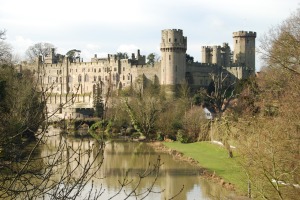
warwick-castle

When Jaime Lannister arrives in the Riverlands, the siege of Riverrun is not going well. Daven Lannister’s forces consist of a contingent of Freys under the command of Ser Ryman, his own Westerland forces, Lord Emmon Frey and Ser Forley Prester’s host and the river lords who bent the knee. The riverlanders are

“A sullen lot…Good for sulking in their tents, but not much more.”

AFfC, Jaime V

Daven tells Jaime that the half the men he sends to forage for supplies never return. Some desert, but others are found dead.

“It might [be] outlaws, or not. There are still bands of northmen about. And these Lords of the Trident may have bent their knees, but methinks their hearts are still… wolfish.”

AFfC, Jaime V

He continues

“My scouts report fires in the high places at night. Signal fires, they think… as if there were a ring of watchers all around us.”

AFfC, Jaime V

Regarding the “bands of northmen” a review of troop numbers is in order. Robb goes to the RW with thirty-five hundred men:

“Thirty-five hundred they were, thirty-five hundred who had been blooded in the Whispering Wood, who had reddened their swords at the Battle of the Camps, at Oxcross, Ashemark, and the Crag, and all through the gold-rich hills of the Lannister west.”

ASoS,Catelyn VI

and

“Thirty-five hundred riders wound their way along the valley floor through the heart of the Whispering Wood, but Catelyn Stark had seldom felt lonelier. Every league she crossed took her farther from Riverrun, and she found herself wondering whether she would ever see the castle again. Or was it lost to her forever, like so much else?”

ASoS, Catelyn VI

We know of those thirty five hundred that most were slaughtered. But maybe not all:

“We found a thousand corpses afterward. Once they’ve spent a few days in the river they all look much the same.”

Edwyn Frey, AFfC, Jaime VII

Roose Bolton arrives with another thirty five hundred:

“Some five hundred horse and three thousand foot, my lady. Dreadfort men, in chief, and some from Karhold. With the loyalty of the Karstarks so doubtful now, I thought it best to keep them close. I regret there are not more.”

ASoS, Catelyn VII

We know he has left a force of some six hundred men at the Green Fork guarding the crossing.

“I left six hundred men at the ford. Spearmen from the rills, the mountains and the White Knife. A hundred Hornwood longbows, some freeriders and hedge knights, and a strong force of Stout and Cerwyn men to stiffen them. Ronnel Stout and Ser Kyle Condon have the command.”

ASoS, Catelyn VII

The Freys have a force of some two thousand that ultimately crosses the Neck with Roose Bolton. I think it’s safe to assume that Robb expected exactly that number to accompany him. But wait! Just a few chapters earlier, at the same strategy meeting where Robb’s will is signed, he reveals his plan to assail Moat Cailin from three sides, including the rear with the aid of Howland Reed. He numbers his force at over 12,000:

“Once I link up with Lord Bolton and the Freys, I will have more than twelve thousand men.”

ASoS, Catelyn VI

Even assuming that the third of Lord Bolton’s strength lost to Ser Gregor (two thousand Norreys, Lockes, Burleys and White Harbor men under Wylis Manderly, putting Roose’s total expected force at over 6,000) were counted in that number, we are left with a few questions. There are still over five hundred unaccounted for- is that the size of the group that accompanied Maege Mormont and Galbart Glover?  Furthermore, did Condon and Stout rejoin Bolton’s forces with their six hundred? I think not, since Theon’s observations of the troops crossing the Neck account for only a little over 5,500:

“Three days later, the vanguard of Roose Bolton’s host threaded its way through the ruins and past the row of grisly [ironborn] sentinels–four hundred mounted Freys clad in blue and grey, their spearpoints glittering whenever the sun broke through the clouds. Two of old Lord Walder’s sons [Hosteen and Aenys] led the van.

[…]

The northmen followed hard behind the van, their tattered banners streaming in the wind. Reek watched them pass. Most were afoot, and there were so few of them. He remembered the great host that marched south with the Young Wolf, beneath the direwolf of Winterfell. Twenty thousand swords and spears had gone off to war with Robb or near enough to make no matter, but only two in ten were coming back, and most of those were Dreadfort men.

[…]

Farther back came the baggage train–lumbering wayns laden with provisions and loot taken in the war, carts crowded with wounded men and cripples. And, at the rear, more Freys. At least a thousand, maybe more: bowmen, spearmen, peasants armed with scythes and sharpened sticks, freeriders and mounted archers, and another hundred knights to stiffen them.”

ADWD, Reek II

Also, we have the fact that of the two thousand men with Wylis Manderly, not all were killed or captured:

“Two-thirds of my strength was on the north side when the Lannisters attacked those still waiting to cross. Norrey, Locke, and Burley men chiefly, with Ser Wylis Manderly and his White Harbor knights as rear guard. I was on the wrong side of the Trident, powerless to help them. Ser Wylis rallied our men as best he could, but Gregor Clegane attacked with heavy horse and drove them into the river. As many drowned as were cut down. More fled, and the rest were taken captive.”

ASoS, Catelyn VII

Admittedly, at this level we are dealing with quite a bit of estimating of troop size. With eyes wide open that George has actually said this is one detail that is frequently wrong in PoVs, it still seems that there is room to believe that among the “bands” Daven mentions, there could be two substantial forces (five to six hundred each) who remain armed and under the command of a warleader, in addition to the scattered remnants of the force from the ford. Upon arriving in the camps at Riverrun Jaime makes note of the river lords’ banners:

“Lychester and Vance… Roote and Goodbrook, the acorns of House Smallford [sic] and Lord Piper’s dancing maiden… the banners he did not see gave him pause. The silver eagle of Mallister was nowhere in evidence; nor the red horse of Bracken, the willow of the Rygers, the twining snakes of Paege… none had come to join the siege”

AFfC, Jaime V

When Jaime meets with Brynden Tully to offer terms, he suggests the Blackfish  take the black

“I will permit you to take the black. Ned Stark’s bastard is the Lord Commander on the Wall”

AFfC, Jaime VI

Tully reacts with suspicion

“Did your father arrange for that as well? Catelyn never trusted the boy, as I recall, no more than she trusted Theon Greyjoy. It would seem she was right about them both.”

AFfC, Jaime VI

Why the comparison with Theon Greyjoy? Because Jon made common cause with Stannis? Seems like laying it on a bit thick to me. While one could make a case that Brynden Tully was far away at Riverrun when the will was signed in Hag’s Mire and is unaware of its contents, as evidenced by his next exchange with Jaime  he is still flying the direwolf of Stark above Riverrun many months later. Surely he is holding out because he knows there is an heir?

“…Does it matter how the boy perished? He’s no less dead, and his kingdom died when he did.”

“You must be blind as well as maimed, ser. Lift your eyes and you will see that the direwolf still flies above our walls.”

AFfC, Jaime VI

Coming from someone who thinks all of Ned and Cat’s children are dead, and has just dismissed the only surviving Stark out of hand, this seems like an odd statement. Is it empty bravado? Or a subtle threat? I think the latter is more the Blackfish’s style. When diplomacy fails, Jaime summons a war council. Lords Piper, Vance of Wayfarer’s Rest and Vance of Atranta are in attendance. Karyl Vance counsels against hanging Edmure to move the Blackfish and has nothing but scorn for Edwyn Frey’s suggestion of arrows smeared with nightsoil. Norbert Vance offers to parlay with his old friend Brynden Tully and Lord Clement Piper scoffs at this idea. An argument with the Freys breaks out and almost comes to violence. Jaime puts Edmyn Frey in his place by reminding him of the Freys double treachery and dismisses the council. Jaime’s next move is to retrieve Edmure from the Freys’ gallows. As he cuts him down he is accosted by Ser Ryman Frey, in company of a camp follower wearing a very curious crown

“…a circlet of hammered bronze… graven with runes and ringed with small black swords”

AFfC, Jaime VI

After engaging in his new favorite sport of Frey bashing, Jaime dismisses Ryman and orders him to leave the crown. Let’s make careful note of two witnesses to the scene. The first is a singer with a woodharp, who can be none other than Tom o’ Sevenstreams. The second is the camp follower herself. We learn that Jaime dismisses Ser Ryman and that not long after  he and his escort of fifteen armed men have been hanged just south of Fairmarket on their way back to the Twins, presumably by the BwB. As Walder Rivers tells Jaime “It is almost as if they knew that he would be returning to the Twins, and with a small escort.” Since we know by the crown’s later reappearance that Ryman did not in fact leave the crown as Jaime ordered, we might assume he was still in the company of the woman as well. Could she have been the source of the BwB’s information? It’s very interesting that Petyr Frey was also in the company of a sex worker just before he was hanged by the BwB. In Merrett Frey’s PoV he thinks “Let them hang him, he brought this on himself. It’s no more than he deserves, wandering off with some bloody camp follower like a stag in rut.” Fast forwarding a bit, notice the speed with which the BwB (in the person of Brienne of Tarth) were able to track Jaime to Pennytree after his visit to Raventree Hall and recall Hildy, the camp follower seen at Raventree with Lord Jonos Bracken. The day Jaime met with Lord Jonos and Lord Tytos (and Hildy) he departed Raventree Hall and arrived at Pennytree the same evening. Around midnight Brienne rode into the camp looking for him. Can it be coincidence that in three cases where the BwB is looking for a target and quickly locates him, there turns out to have been a camp follower in his presence? Is the BwB is using women to soft target individuals? While there’s probably a much more massive plan in the works, this would speak volumes about BwB operations possibly being much more covert and sophisticated than we thought.

Back to Riverrun, Jaime delivers his terms to Edmure in the presence of his squires (Josmyn Peckledown, Garrett Paege and Lew Piper), Pia and the singer (Tom o’ Sevens): Convince the Blackfish to yield the castle and the smallfolk can remain unharmed, the garrison (including Ser Brynden) will all have the option of taking the black and Edmure can choose between the Wall and captivity with his wife and child at Casterly Rock. If he refuses:

“…my coz will bridge your moat and break your gate. Hundreds will die, most of them your own. Your former bannermen will make up the first wave of attackers, so you’ll start your day by killing the fathers and brothers of men who died for you at the Twins. The second wave will be Freys, I have no lack of those. My westermen will follow when your archers are short of arrows and your knights so weary they can hardly lift their blades. When the castle falls, all those inside will be put to the sword. Your herds will be butchered, your godswood felled, your keeps and towers will burn. I’ll pull your walls down, and divert the Tumblestone over the ruins. By the time I’m done no man will ever know a castle once stood here … Your wife may whelp before that. You’ll want your child, I expect. I’ll send him to you when he’s born. With a trebuchet.”

AFfC, Jaime VI

Jaime departs and leaves Edmure to be entertained by the singer

“I’ll leave you to enjoy your food. Singer, play for our guest whilst he eats. You know the song, I trust.”

“The one about the rain? Aye, my lord, I know it.”

Edmure seemed to see the man for the first time. “No. Not him. Get him away from me.”

AFfC, Jaime VI

Presumably there followed an interesting interlude between Edmure Tully and Tom o’ Sevenstreams, who beyond doubt is the singer and also one of the chief lieutenants of Lady Stoneheart’s band of outlaws. The flies on the wall? Garrett Paege and Lew Piper. We can only guess at what messages were relayed, or if plans were laid. The opportunity was certainly there however. Next we see Jaime and Edmure is in the great hall of Riverrun. The Blackfish has slipped out by the water gate under cover of night. Edmure waited almost the entire day before surrendering the castle to the Lannisters. As Jaime says, the Blackfish could be ten leagues downstream. Ten leagues downstream would place him in the vicinity of Fairmarket, where Ryman Frey was waylaid  and the last known location of Lady Stoneheart’s band of the BwB, and within a very short distance of Pennytree, location of the next act in the drama. Jaime is not amused.  He thinks:

“For a man who was going to spend the rest of his life a prisoner, Edmure was entirely too pleased with himself.”

AFfC, Jaime VII

Emmon Frey is apoplectic. He wants Edmure punished. After being told by his wife that he must hold the castle or abandon it, Ser Emmon replies

“To be sure. Riverrun is mine, and no man shall ever take it from me.”

AFfC, Jaime VII (emphasis mine)

Foreshadowing of the retaking of Riverrun by Lady Stoneheart, who now has an operative inside the castle?

“…this castle seems a nice place to spend the winter”

Tom o’Sevens, AFfC, Jaime VII

Yes… but with whom? Edmure Tully and the Westerlings  are sent to Casterly Rock with a guard of 400 men under the command of Ser Forley Prester. The Riverrun garrison is allowed to depart: stripped of arms and armor they vanish into the Riverlands. Ser Desmond Grell and Ser Robin Ryger elect to take the black. They are dispatched to take ship at Maidenpool with an escort of twelve of Gregor Clegane’s men under the command of Raff the Sweetling. In the process of departing Riverrun, Jaime takes leave of the Freys. They are wroth about Ser Ryman’s death. Jaime is unmoved, and repeats the order he first issued in front of Edmure Tully and Tom o’ Sevenstreams to Ser Ryman:

“King Tommen requires all the captives you took at the Red Wedding.”

AFfC, Jaime VII

Next he grants the river lords leave to return to their own lands. He promises Lord Piper that the captives will be ransomed and hears the advice of Lord Karyl Vance

“Lord Jaime, you must go to Raventree. So long as it is Jonos at his gates Tytos will never yield, but I know he will bend his knee for you.”

AFfC, Jaime VII

Worth noting is this passage in ASoS ch. 43: When discussing what to do with Arya, Lord Beric says

“Still, we dare not go blindly here. I want to know where the armies are, the wolves and lions both. Sharna will know something, and Lord Vance’s maester will know more. Acorn Hall’s not far. Lady Smallwood will shelter us for a time while we send scouts ahead to learn…”

One reason this passage may be somewhat overlooked is because this is the moment that Arya runs away from the BwB straight into the arms of Sandor Clegane.  We know Sharna is the innkeep at the Inn of the Kneeling Man and we’ve seen the BwB at Acorn Hall before, but Lord Vance’s maester is a pretty high level contact and possibly not unrelated to the fact that it is ultimately Lord Vance who urges Jaime to venture to Raventree Hall, thus putting himself in BwB territory. At Raventree Jaime meets Jonos Bracken and Tytos Blackwood, and learns more than a little about the ancient Bracken-Blackwood feud. Bracken appears to have well and truly turned his cloak. Blackwood is more pragmatic, and close. He enquires about Edmure and Brynden Tully, giving nothing away. When the talk turns to hostages we learn two things.  Brynden Blackwood is the heir, whose whereabouts are never mentioned. Since his next younger brother Lucas was with Robb at the RW, it may be safe to consider that Brynden was also a part of Robb’s forces, but in an as yet unidentified deployment. Lucas perished at the RW in spite of kin ties with the Freys. Jaime promises to have his bones returned (probably an empty promise since just recently the Freys  have admitted to him that they dumped many bodies anonymously into the river)  As Jaime takes his leave he mentions that Riverrun awaits. Blackwood makes this odd rejoinder

“Riverrun? Or King’s Landing?”

ADwD, Jaime I

…almost as if he wanted to ascertain Jaime’s next steps. Could this be a further hint of an undercurrent of communication regarding the Lord Commander’s movements? What happens next is well known. Jaime and his tail camp at Pennytree. At midnight his scouts return with a woman who has ridden up asking to be brought to him. Brienne of Tarth tells Jaime she has found the girl with the Hound, and that he must come at once and alone or she will be killed. We know from Kevan’s later conversation with Cersei while she is imprisoned by the Faith, that  he does indeed depart with her, and up to the point we have knowledge, has not been heard from since. Of course, most speculation goes that Brienne has agreed to bring Jaime to the BwB in exchange for Podrick’s (and maybe Ser Hyle’s) life. We can only wait to see what will happen at this confrontation and although it might seem a foregone conclusion, I’m not so sure.

Returning to Pennytree, we have Jaime’s men (described as a “tail”, so a relatively small force) left leaderless in the Riverlands. It seems plain that they make it make to Riverrun, since word has reached Kevan that Jaime vanished with a woman, possibly Lady Brienne. I wonder about the three boys though- Lew Piper, Garrett Paege and Hoster Blackwood. The first two may have overheard the conversation between Edmure Tully and Tom o’ Sevenstreams. All three are aware of the escape of the Blackfish and at least some of the movements of the BwB. Hos would know the countryside well– would the confusion of Jaime’s departure be a good occasion for the hostages to depart? Or do they remain as eyes and ears in the Lannister camp? Either way, I don’t think we can ignore their presence and the fact that the sons of some of the more Stark-loyal riverlords are together. Once Marq Piper is freed from the Twins, if these three escape, the Lannisters will have no hold over this particular trio of families. As for the freedom of Marq Piper, Greatjon Umber and any other captives from the Twins, it is plain that Tom o’ Seven knows of the order to send the captives to King’s Landing. Since the Frey forces are currently spread between Winterfell, Seagard, Darry and Riverrun, I suspect the captives will be put on the Kingsroad with inadequate guards and waylaid by the BwB. So now we have Edmure and Jeyne Westerling heading west under a strong guard of four hundred. The Blackfish is at large and the Riverrun garrison has been set free, albeit unarmed. Jaime is alone in the Riverlands with Brienne, his tail left leaderless. Ryger and Grell are heading east, armed, under light guard. Riverrun is garrisoned with a force of two hundred Freys or Lannisters, but they have a senior member of the BwB in their midst. Any castle can be taken if the enemy can gain access, and the enemy now have the means to open the gates. The BwB has become increasingly bold, hanging Lord Walder’s heir and his escort of fifteen armed men less than a day’s march from the Twins. Undefined “bands” of Stark supporters remain at large, possibly numbering in the thousands. It’s worthy of note that with the forthcoming release of the captives from the Twins and abandonment of Jaime’s tail at Pennytree (which includes not only Hoster Tully, Garrett Paege and Lew Piper, but also Ser Hugo Vance, one of the sons of Lord Norbert Vance of Atranta, who has been acting as Jaime’s standard-bearer) and the recent capitulation of Riverrun, the only remaining hostages the Lannisters have in their control are Edmure Tully and Jeyne Westerling. Roslin Tully presumably will remain at the Twins, where her child is certainly at risk once it is born, but anyone seeking to save or sacrifice it will first need to breach the Twins.

Also of extreme interest is that the Blackfish was presumably the mastermind behind the great Stark-Tully victory at Oxcross, which involved circumventing the Golden Tooth via a secret path discovered by Grey Wind. With  the Riverrun garrison at large, I propose that the Blackfish means to take command of them once more and set out for the Westerlands to ambush Forley Prester’s party and free Edmure and Jeyne, whose safety he has been charged with. In support of this idea, let’s recall the Tully words– “Family, Duty, Honor.” We learn in ASoS that upon his departure from Riverrun, King Robb named his great-uncle Warden of the Southern Marches, and charged him with Queen Jeyne’s protection. It’s seems likely that Brynden Tully would fulfill his duty as Warden of the Southern Marches and protector of the Queen, rescue Jeyne and his nephew, his last surviving family, and annihilate the Lannister host under Forley’s command. Even more compelling is the idea that to stand and fight is perhaps the most honorable and therefore characteristic action the Blackfish could take. The problem with this idea was the lack of PoV characters in the area to relay such a significant event. But we recently received a strong indication from GRRM himself that we will see Forley’s host early in TWoW. In an interview at the San Diego Comic Con last summer George revealed that we will see Jeyne Westerling in the Prologue of TWoW. So an ambush of the Prester party, with possibly Ser Forley himself as the viewpoint character, seems a strong possibility.

The problem of arms for the garrison could be solved by the BwB, who seem to have no problem overcoming good sized groups of armed men. Besides the demonstrated availability of abandoned arms and armor throughout the Riverlands, each group of twelve or fifteen men they ambush or kill adds to their supply. Then there’s Gendry—one has to wonder exactly what he’s been doing at his forge at the Inn. Gendry has been demonstrated to have the knowledge for blade forging. In the many months he has been at that forge, there can be no doubt he has had time to forge (given the raw materials) or mend a great deal of weapons. The ambush of Prester’s party cannot happen in isolation though. In order to preserve the delicate balance of rescue operations, there must be an established communications network. Let’s revisit the words of Daven Lannister:

“My scouts report fires in the high places at night. Signal fires, they think… as if there were a ring of watchers all around us.”

I think the BwB have established a communication network that involves signal fires (we know from his remarks to Brienne that Thoros isn’t spending a lot of time fire gazing these days) and spies. From Lord Vance’s maester to Lady Smallwood to Sharna the innkeep to Tom o’ Sevens inside Riverrun, they seem to have endless capacity to get the downtrodden people of the Riverlands to cooperate with them. The hostages from the Twins will be released, one way or another, by the BwB themselves. Ryger and Grell, by this time, are most like en route to Eastwatch. Weather may play a part in their journey, but as Tycho Nestoris was able to reach it, so should they. What messages, if any, they bring is anyone’s guess, but we know they had ample opportunity to receive them from both the Blackfish and Edmure. This will leave Riverrun and the Twins. With Tom o’ Sevens inside, Riverrun will fall at a time of Lady Stoneheart’s choosing. The fall of the Twins, will be carefully planned to coincide with Lord Walder’s death. We have had plenty of indication of the chaos that will occur when that happens, most clearly in Merrett Frey’s POV when he thinks “It was like to be every son for himself when the old man died, and every daughter as well.” Looking at Jaime’s interview with Maria and Amarei Frey at Castle Darry, they told him:

“Some of the river lords are hand in glove with Lord Beric’s men as well … The smallfolk too … Ser Harwyn says they hide them and feed them, and when he asks where they’ve gone, they lie. They lie to their own lords!”

Put together with all the evidence just discussed, it seems plain that the BwB have politicized their agenda in the Riverlands and with all the hints at plotting, spies and conspiracies, it’s likely we’re going to see a lot more of that agenda in TWoW. It also seems reasonable to conclude from all the hints and the overarching theme of revenge that in the opening pages of TWoW the Riverlands are going to become a shitstorm of Stark and Tully vengeance.

While the Riverlands web is still separate from what is happening in the north, I predict an intersection of political agendas of the two areas in the future (thus the title of this essay) For a thorough analysis of the original Great Northern Conspiracy, I can think of no better place to look than here– Yeade has written up the theory brilliantly in eight parts, with appropriate links to the original posts at Westeros that introduced it. Further in depth reading can also be found here– the Winterfell Huis Clos by Bran Vras is an intimate deconstruction of Theon’s ADwD chapters, well worth a perusal by interested parties. Finally, Yolkboy and I discuss this subject in Episode 09 of Radio Westeros.

Image of Warwick Castle © Great-Castles.com